
Should I Pull a Regular FICO Score or a VantageScore for My Arizona Mortgage?
FICO or VantageScore for Your Mortgage? | Peoria AZ Broker Joe Hansen
I get asked a version of this question almost every week now: “Joe, should I be pulling my regular FICO score or this new VantageScore thing?” The honest answer is — you don’t have to choose. As a mortgage broker working with Peoria and West Valley buyers, I can pull both, and for a lot of my clients, that’s exactly what I do before we ever pick a lender.
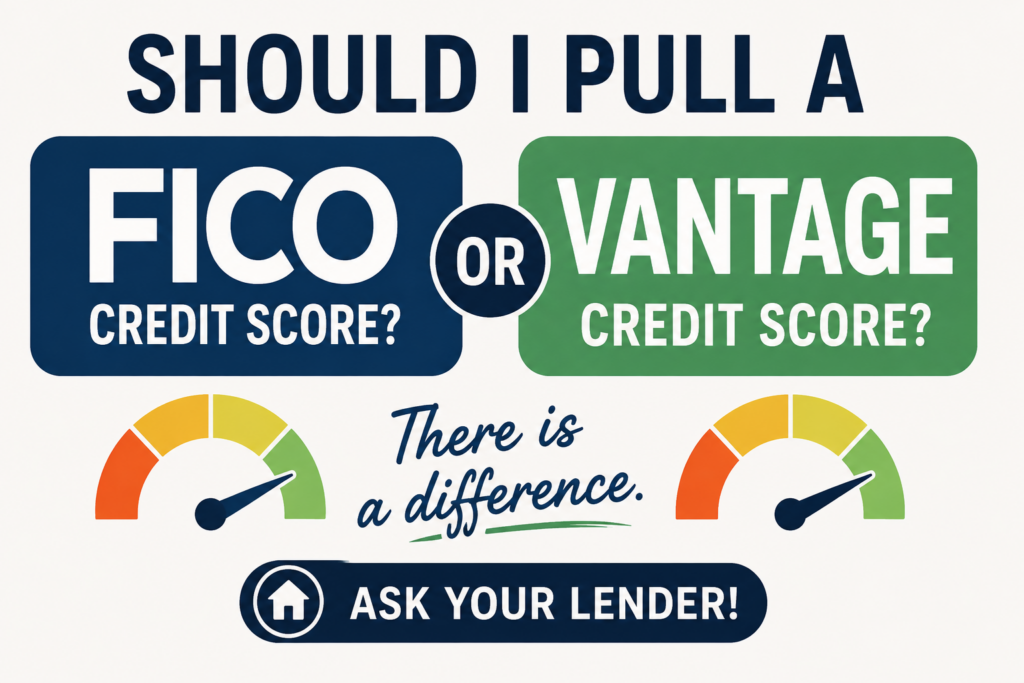
For more than twenty years, if you wanted a conventional mortgage, the credit score that mattered was Classic FICO. Full stop. That changed in 2026. A second, federally approved credit-scoring model — VantageScore 4.0 — is now in use across the conventional and FHA mortgage market, and depending on your lender, it could be the difference between qualifying and not qualifying, or between a good rate and a great one.
Here’s the short version, then we’ll go deep — including where I’ve seen this actually change outcomes for Arizona buyers I’ve worked with.
The Quick Answers
Can I actually use VantageScore for my mortgage?
In many cases, yes. As of April 22, 2026, Fannie Mae, Freddie Mac, and FHA all allow approved lenders to use VantageScore 4.0 in place of Classic FICO. It’s not universal — your specific lender has to be approved and has to offer it for your loan type — but adoption moved fast. By June 2026, the 30 largest mortgage originators in the country, including Rocket Mortgage and UWM, had it in place.
How does it actually work?
VantageScore 4.0 uses the same 300–850 range as FICO, but it reads your credit report differently. It looks at trended data (are your balances going up or down over time, not just where they sit today), it can factor in on-time rent and utility payments when those are reported, and it doesn’t count medical collection debt at all. A lender chooses one model or the other for your entire loan — not a mix-and-match between models or between co-borrowers.
Is it better for me?
It might be. Research from the Urban Institute found VantageScore 4.0 runs about 14 points higher than Classic FICO on average — and for borrowers with a Classic FICO under 640, the gap widens to nearly 27 points higher, on average. That’s not guaranteed for every person, but if your credit is borderline, it’s a real reason to have both scores pulled before you decide on a lender.
So which one should I actually pull — FICO or VantageScore?
Both, if there’s any question about where you stand. As a broker, I have access to lenders on the VantageScore Advantage program alongside traditional FICO lenders, so I can run your numbers both ways before we ever choose a loan and a lender. You don’t have to guess or gamble on one score — we look at what actually gets you the better outcome.
Why This Matters More Than It Sounds Like It Should
This isn’t just a new number on a page. For roughly two decades, the entire conventional mortgage system leaned on one scoring family. Congress opened the door to competition back in 2018 through the Credit Score Competition Act, which required the Federal Housing Finance Agency (FHFA) to create a path for additional, validated credit-scoring models. FHFA validated both VantageScore 4.0 and FICO 10T back in October 2022, then spent a few years working through implementation.
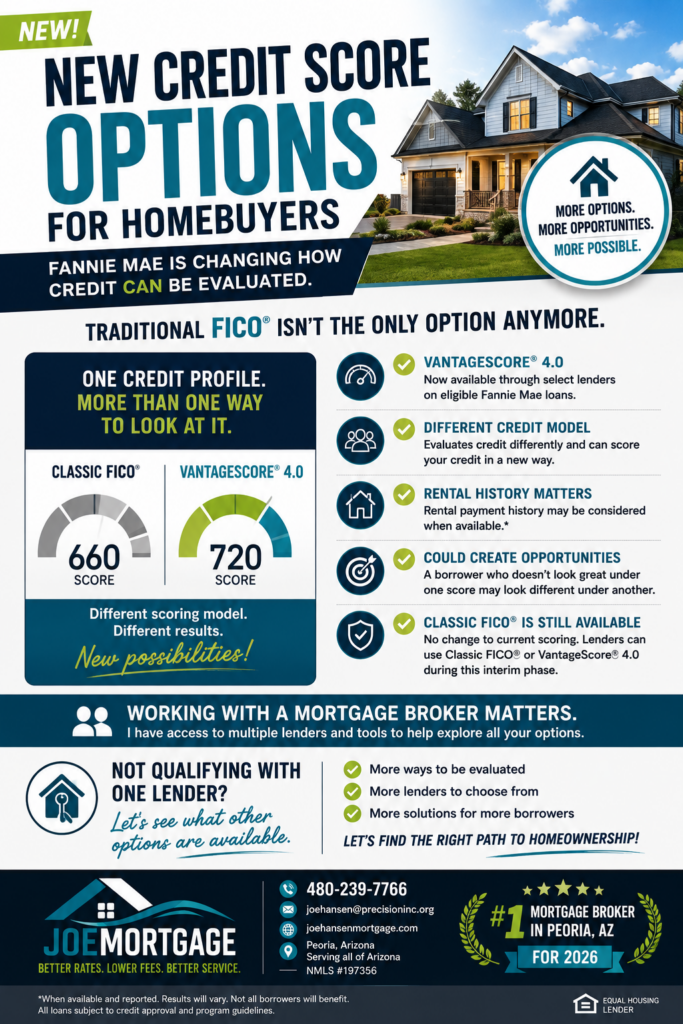
The real shift happened on April 22, 2026, when FHFA and HUD jointly announced full implementation: Fannie Mae, Freddie Mac, and FHA would all begin accepting VantageScore 4.0 from approved lenders, with FICO 10T expected to follow later. Twenty-one large lenders launched in the first wave. By early May, Freddie Mac alone had already processed $10 million in loans approved using VantageScore. By June, it had reached the 30 largest mortgage originators in the country.
So the honest way to describe this: the conventional mortgage system now has a second, federally approved way to measure your credit risk — and which one your lender uses can change your outcome.
What Is VantageScore 4.0, Really?
VantageScore was created back in 2006 as a joint effort between Equifax, Experian, and TransUnion. Version 4.0 is the current generation, and like FICO, it scores you on a 300–850 scale. But the way it reads your credit file is meaningfully different in three ways that matter for a mortgage application.
1. It looks at trends, not just snapshots
Classic FICO has historically leaned heavily on where your credit stands right now. VantageScore 4.0 also looks at the direction you’ve been heading.Example: two borrowers each owe $8,000 on credit cards today.
| 6 months ago | Today | Direction | |
|---|---|---|---|
| Borrower A | $18,000 | $8,000 | Paying down steadily |
| Borrower B | $2,000 | $8,000 | Increasing steadily |
A snapshot makes these two borrowers look identical. Trended data doesn’t.
This tends to matter most for people who spent the last 6–12 months intentionally cleaning up their credit before buying a home — which describes a lot of the people I work with.
2. Rent and utility payments can count — with a catch
FHFA specifically notes that the newer approved models can factor in rent, utility, and telecom payment history when that information is available in your credit data. The catch is right there in that phrase: when available. Paying your landlord on time for five years doesn’t automatically show up on your credit report. It has to actually be reported into the credit-reporting system for the model to use it. So this is a real potential benefit for renters and first-time buyers — but it isn’t automatic.
3. Medical collections don’t count at all
VantageScore stopped factoring in medical collection debt back in 2023, regardless of the amount or how old it is. This is one of the clearest, most predictable ways a borrower could see a real gap between their two scores. If you’ve got a medical collection dragging down your FICO, your VantageScore could look noticeably different.
Potential Advantages
- Thinner credit files can still be scored — VantageScore says it can score roughly 94% of U.S. adults
- Rewards borrowers who’ve been paying down debt, not just where they stand today
- Medical collections are excluded entirely
- Reported rent history can help first-time buyers with limited traditional credit
- A higher score can improve pricing and mortgage insurance costs — even for borrowers who already qualify
- Gives lenders and brokers a second path when Classic FICO says no
Real Limitations
- It is not guaranteed to be higher — some borrowers score lower under VantageScore
- Not every lender offers it yet, and overlays vary widely between the ones that do
- Rent only helps if it was actually reported — it doesn’t appear automatically
- A better score doesn’t fix debt ratio, income, or asset issues
- It adds another layer of “which score is my real score” confusion for consumers
Is VantageScore Actually Higher on Average? Here’s the Data
This is where it’s worth being precise instead of just repeating marketing claims. The Urban Institute studied a large set of Fannie Mae mortgage data comparing Classic FICO to VantageScore 4.0 and found that, on average, VantageScore scores ran about 14 points higher. That gap wasn’t evenly distributed, though — it was much larger at the lower end of the credit spectrum:
- Borrowers with a Classic FICO under 640 saw a VantageScore that was, on average, about 27 points higher
- Borrowers in the 640–679 range saw a gap of about 23 points higher, on average
- The gap narrowed for borrowers who already had strong credit
In plain terms: if your credit is already excellent, the two scores probably land close together and it may not matter much which one your lender uses. If your credit is borderline, that’s exactly where the gap tends to be biggest — and where it’s most worth checking both.Worth knowing: This isn’t a settled, uncontested debate. VantageScore has published its own research claiming an even larger predictive advantage over Classic FICO, while independent researchers at the American Enterprise Institute have challenged those specific claims as methodologically flawed. VantageScore, in turn, has raised questions about funding behind some of the comparison research. I’d treat any single source’s “our score is better” claim with a healthy amount of skepticism — including VantageScore’s own marketing. What’s not in dispute is that FHFA required both models to pass independent validation standards for accuracy and reliability before approving them, and both did.
This Can Affect More Than Whether You Qualify — It Can Affect What You Pay
This is the part that gets missed. Credit scores on a conventional loan don’t just determine yes or no. They drive pricing — specifically loan-level price adjustments and private mortgage insurance costs. That means there are two separate ways a higher VantageScore can help you:
- Qualification. A borrower who doesn’t qualify at 612 might qualify at 634.
- Cost. A borrower who already qualifies at 719 under FICO might land at 741 under VantageScore. If that crosses a pricing tier, it can mean a better rate, lower fees, or cheaper mortgage insurance — even though they would have been approved either way.
When large lenders started rolling this out, several publicly reported that borrowers who already qualified under FICO were getting meaningfully better pricing once VantageScore was used instead — better rates, better terms, better mortgage insurance costs. That’s the piece I’d want any borrower with marginal-to-good (not perfect) credit to understand: even if you’re already approvable, it’s worth asking whether the other score changes your cost.
This is exactly why I don’t think “who has the lowest rate” is a complete question anymore on its own — I wrote about who actually has the lowest mortgage rates in Peoria, AZ and why the advertised rate rarely tells the whole story. Your credit-score model can move that rate before a lender even quotes you.
Not Every Lender Offers This Yet — And That’s the Whole Point of Shopping It
This is still a rolling adoption, not a universal switch. Fannie Mae and Freddie Mac describe it as a limited rollout among approved lenders. Some of the country’s largest originators — Precision mortgage works with -, UWM, NewRez, and others among the top 30 — have implemented it. Plenty of smaller and regional lenders haven’t been approved yet and are still required to use Classic FICO only.
And even among lenders that do offer it, the fine print varies. One lender might allow VantageScore on a conventional purchase but restrict it to primary residences with a lower maximum loan-to-value. Another might allow it on VA loans and FHA Streamline refinances but not standard purchases. The agency permission is one thing; each lender’s actual implementation is another.
That’s exactly why it’s worth working with someone who can check both models and knows which lenders in their network have it turned on for the loan program you actually need — rather than assuming “my bank offers VantageScore” means every product at that bank uses it.
This is also where being a mortgage broker, rather than a single bank or a single retail lender, actually matters. A loan officer at one bank can only offer whatever that one bank has approved — if their institution hasn’t turned on VantageScore, you’re stuck with FICO, whether or not it’s the better outcome for you. As a broker, I’m not tied to one lender’s rulebook. I work with lenders on the VantageScore Advantage program as well as traditional FICO lenders, so we can shop the scoring model right alongside the rate and the loan program. And if you’ve already started the process somewhere else and are wondering whether it’s too late to make a change, I’ve also written about whether you can switch lenders after signing a purchase contract.
When it’s especially worth pulling both scores: If you’re going conventional and your credit is sitting in the high 500s to mid-600s, this is the range where I most often see a real gap between the two models — and where that gap can be the difference between paying private mortgage insurance at a higher rate, qualifying at a better rate tier, or not qualifying for conventional financing at all. On a conventional loan with lower credit scores, I’ll routinely pull both before we lock in a lender, specifically because of how much PMI pricing can move with even a 20-point swing.
Who Benefits the Most?
Based on how the model is built, a few borrower profiles stand out as the most likely to see a meaningful difference:
- Borrowers with a medical collection on their report. This is excluded entirely from VantageScore 4.0.
- Borrowers who’ve spent the last several months paying down credit card debt. Trended data can reward that trajectory specifically.
- First-time buyers with thin credit files but a strong rent-payment history. If that rent history has been reported, it can help fill in a file that otherwise looks sparse.
- Borrowers with dormant or limited traditional credit use. VantageScore is built to be able to score more people than older models.
- Borrowers who are on the edge of a pricing tier, even if they already qualify — because a small score bump can lower cost, not just improve approval odds.
If your credit is already excellent across the board, don’t expect this to move much. The bigger story here is for people sitting in that uncomfortable middle zone — approvable, but paying more for it, or right on the edge of qualifying at all.
Don’t Confuse This With Your Credit Karma Score
This trips people up constantly, and it’s about to get worse. If you check Credit Karma, the “VantageScore” you’re seeing is version 3.0 — not the 4.0 model being used for mortgages. Different version, potentially different bureau data, different date pulled. Seeing a 725 on an app doesn’t tell you what your mortgage VantageScore 4.0 will be, the same way your Credit Karma “FICO-like” number has never reliably matched your actual mortgage FICO. There are multiple versions of both scoring families. The number on your phone and the number your lender pulls are not the same thing.
A Better Score Doesn’t Replace Underwriting
It’s worth saying plainly: neither score decides your loan on its own. Fannie Mae’s own automated underwriting system, Desktop Underwriter, doesn’t use a third-party credit score as its primary risk decision at all — it relies on a broader proprietary risk assessment. The score still matters for pricing, mortgage insurance, and some product eligibility requirements, but a 20-point bump doesn’t fix a debt ratio that’s too high, insufficient income, or a property that doesn’t qualify. Think of the score as one important input into a bigger picture, not the whole picture.
So Should You Ask to Have Both Scores Pulled?
If your credit is strong across the board, probably not necessary — the two models are likely to land close together and neither should change your outcome much.
If your credit is marginal — sitting near a qualifying threshold for a conventional loan, dealing with a medical collection, carrying debt you’ve been actively paying down, or worried about the cost of mortgage insurance because of a lower score — this is exactly the situation where it’s worth asking. A meaningful gap between the two scores could mean the difference between qualifying and not, or between paying more in rate and mortgage insurance versus less.The better question to ask your loan officer isn’t “what’s my credit score?” It’s “have you checked whether Classic FICO or VantageScore gives me the better outcome, and do you have access to lenders who can use either one?”
Why I Pay Close Attention to This as a Peoria Mortgage Broker

I’ve spent more than 20 years originating mortgages across the Phoenix West Valley, and a good chunk of that time has gone into something most loan officers don’t do: teaching. I’ve taught continuing education classes to Arizona realtors on credit for over a decade — helping agents understand what’s actually happening behind a buyer’s credit score, why two buyers with the same number can qualify very differently, and what can realistically be done to improve a score before closing.
That background matters here for a simple reason. VantageScore and FICO don’t just spit out a number — they reward different behaviors. Knowing which behaviors move which score is exactly the kind of detail I’ve spent years walking realtors and clients through, from paying down specific balances in a specific order to understanding why a medical collection might be hurting one score and not the other. When a client comes to me with credit that’s sitting on the edge, I’m not just pulling a report and hoping — I’m looking at what’s actually driving the number and whether there’s a faster, smarter path to qualifying, or qualifying for better pricing.
That’s also the practical case for working with a broker instead of a single retail lender or bank loan officer. As a broker, I’m not limited to one institution’s credit-scoring policy. I can shop your loan across lenders that use Classic FICO and lenders on the VantageScore Advantage program, and match you with whichever combination of score, program, and lender actually gets you the best outcome — not just the only outcome one bank happens to offer. It’s part of why I was named the #1 mortgage broker in Peoria for 2026 — this kind of detail work on credit is a big part of how I try to earn that every day, not just something I put on a landing page.
What’s Next
This is likely the early stage of a longer transition, not the finished product. FICO 10T — an updated FICO model — is still working through implementation, and Fannie Mae and Freddie Mac released additional historical data on both models in July 2026 to help lenders and investors prepare. Longer term, FHFA has also discussed moving from the traditional three-bureau credit report toward an optional two-bureau report, though that hasn’t been implemented yet. For now, credit scoring in the mortgage world is becoming less about one fixed number and more about which approved model — and which lender — fits your specific credit profile.
Not Sure Which Score Puts You in the Best Position?
If your credit is anywhere near the edge of qualifying, or you’re trying to avoid paying more than you should in rate or mortgage insurance, it’s worth having both scores checked before you commit to a lender. I work with lenders across both models and can help you see where you actually stand.Start Your Application
Frequently Asked Questions
Can I use VantageScore instead of FICO for my mortgage?
In many cases, yes. As of April 2026, Fannie Mae, Freddie Mac, and FHA all permit approved lenders to use VantageScore 4.0 instead of Classic FICO. It depends on whether your specific lender has been approved and has turned it on for your loan type, so it isn’t automatic at every lender yet.
Is VantageScore always higher than FICO?
No. On average, research shows VantageScore 4.0 tends to run higher than Classic FICO, and the gap tends to be largest for borrowers with lower scores. But it isn’t guaranteed for every individual — some borrowers actually score lower under VantageScore. That’s exactly why it’s worth checking both rather than assuming.
Why would VantageScore be higher than my FICO score?
VantageScore 4.0 uses trended credit data (whether your balances are trending up or down over time), can factor in on-time rent and utility payments when reported, and excludes medical collection debt entirely. Those differences tend to help borrowers who’ve been actively paying down debt or who have thinner credit files.
Does every mortgage lender offer VantageScore?
No. It’s still a rolling adoption. Large lenders like Rocket Mortgage and UWM have implemented it, but many smaller and regional lenders haven’t been approved yet. Even among lenders that offer it, individual overlays — like property type or loan-to-value limits — can vary.
Should I pull both my FICO and VantageScore before applying?
If your credit is borderline for the loan program you want, or you’re concerned about qualifying for the best conventional pricing and avoiding higher mortgage insurance costs, it’s worth asking your loan officer to check both. A meaningful gap between the two scores can affect approval, your interest rate, and your mortgage insurance cost.
Can a mortgage broker in Peoria, AZ pull both FICO and VantageScore?
Yes. As a broker rather than a single bank, I work with lenders on the VantageScore Advantage program as well as traditional FICO lenders, which means both scores can be checked before we choose a lender for a conventional or FHA loan. Joe Hansen | NMLS# 217716 | Precision Mortgage | AZ LO0911403 | 14155 N 83rd Ave Ste 125, Peoria, AZ 85381 | (480) 239-7766
This article is for general informational purposes only and does not constitute a commitment to lend or an offer of credit. Program availability, credit score model usage, and pricing vary by lender and are subject to change without notice. Not all borrowers will qualify. Equal Housing Opportunity.
