
Renting vs. Buying a Home in Peoria, AZ: The Real Numbers Behind the Decision in 2026
Renting vs. Buying a Home in Peoria, AZ (2026): The Real Numbers Behind the Decision | Joe Hansen
Rent vs. Buy · Peoria, AZ · 2026 Real Numbers
Renting vs. Buying a Home in Peoria, AZ: The Real Numbers Behind the Decision in 2026
Most rent vs. buy comparisons are written generically. This one isn’t. These are actual Peoria rental figures, actual Peoria sale prices, and real mortgage payment calculations for FHA, VA, and conventional loans — broken down by neighborhood and down payment scenario. By Joe Hansen, NMLS# 217716 · Precision Mortgage, Peoria AZ · Updated July 2026
The rent vs. buy question comes up in almost every first conversation I have with buyers in the West Valley. And most of them are working from assumptions — assumptions about how expensive buying is, about how high rates are, about whether now is the right time. Some of those assumptions are accurate. Some are holding people back from a decision that would genuinely serve them better. This post is my attempt to put real Peoria numbers on paper so you can make this comparison with actual information instead of guesswork. $2,133 Average rent for a 3-bed single-family home in Peoria, AZ (2026) $540,000 Median single-family home sale price, Peoria AZ (2026) $441,000 Median sale price in the 85382 zip — Arrowhead / Fletcher Heights corridor
Understanding the Peoria Market Before You Run the Numbers
Peoria is a genuinely large city — over 180 square miles and a population pushing 200,000 — which means “Peoria prices” cover a lot of ground. A home in Vistancia in north Peoria (85383) carries a different price tag than a home in Fletcher Heights or along the Arrowhead corridor in 85382. Knowing where you want to live matters before the rent vs. buy math means anything.
For this analysis, I’m going to anchor on two specific areas that come up frequently in conversations with West Valley buyers: Desert Harbor and Fletcher Heights — both established neighborhoods in central Peoria that offer genuinely different profiles from the master-planned communities further north. Neighborhood Spotlight
Desert Harbor — Peoria’s Lakefront Community
Desert Harbor is one of Peoria’s most distinctive neighborhoods, built around a private lake in the heart of the city near 75th Avenue and Olive. Homes here are larger, lots are mature, and the community has an established character you simply don’t find in newer construction. Single-family homes in Desert Harbor typically list in the $450,000 to $700,000 range depending on size and whether they have lake views or dock access. Renters in this pocket of Peoria are often paying $2,400 to $3,000 per month for a 3-bedroom home — sometimes more for anything with water access.
The appeal is easy to understand. What’s harder to quantify is what it costs to rent here long-term vs. what it costs to own — and how dramatically that equation shifts over a 5 to 10-year window. Neighborhood Spotlight
Fletcher Heights — Established Value in Central Peoria
Fletcher Heights sits in the 85382 zip code — the Arrowhead corridor — and it’s one of the best value pockets in the city. Established streets, mature landscaping, quick access to the 101 freeway, and proximity to Arrowhead Towne Center and the P83 district make it consistently popular with families and first-time buyers. Median sale prices in this zip code sit around $441,000 as of mid-2026, making it one of the more accessible entry points into Peoria homeownership. Average rents for a 3-bedroom in Fletcher Heights run $2,000 to $2,300 per month — sometimes higher for renovated homes.
With those two neighborhoods in mind, let’s run the actual numbers.
What You’re Actually Paying to Rent in Peoria Right Now
Renting in Peoria has gotten meaningfully more expensive over the last several years. Based on current market data, here’s what tenants are paying for single-family homes across the city right now: 3-bedroom single-family home (Peoria average): $2,133/month 3-bedroom in the Fletcher Heights / Arrowhead area: $2,000–$2,300/month 3-bedroom in Desert Harbor (lakefront adjacency): $2,400–$3,000+/month 4-bedroom single-family (Peoria average): $2,533/month
That’s the starting point. But what most renters don’t account for is the compounding nature of rent increases. Arizona has no rent control. If you’re renting a home at $2,200 today and your landlord raises it 4% annually — which is conservative by recent market standards — you’ll be paying $2,666 by year five and $3,243 by year ten. Over ten years, that same home costs you roughly $290,000 in rent payments, with zero equity to show for it, zero tax benefit, and no ownership at the end.
That doesn’t automatically mean buying is the right call for everyone. But it does mean the rent vs. buy analysis has to account for trajectory, not just where the numbers sit today.
What Buying Actually Costs Per Month in Peoria in 2026
Let’s build real payment scenarios using current market conditions. I’m going to model three loan types — conventional at 6%, and FHA and VA at 5.25%, which reflects the current rate environment — across two different purchase prices that reflect the Fletcher Heights and Desert Harbor markets.
Scenario 1: $440,000 Purchase — Fletcher Heights / Central Peoria
Conventional Loan — $440,000 · 3% Down · 6.00% Rate Down Payment (3%) $13,200 Loan Amount $426,800 Principal & Interest $2,559/mo PMI (~0.8%) +$284/mo Property Taxes (~0.62% annually) +$227/mo Homeowners Insurance +$155/mo Total Monthly Payment ~$3,225/mo FHA Loan — $440,000 · 3.5% Down · 5.25% Rate Down Payment (3.5%) $15,400 Loan Amount (with 1.75% upfront MIP rolled in) $432,975 Principal & Interest $2,390/mo Annual MIP (0.55%) +$198/mo Property Taxes +$227/mo Homeowners Insurance +$155/mo Total Monthly Payment ~$2,970/mo VA Loan — $440,000 · 0% Down · 5.25% Rate (eligible veterans) Down Payment $0 Loan Amount (2.15% funding fee rolled in for first-time use) $449,460 Principal & Interest $2,480/mo PMI / MIP $0 — none required Property Taxes +$227/mo Homeowners Insurance +$155/mo Total Monthly Payment ~$2,862/mo
A quick glance at those numbers shows the FHA payment at $2,970 and the VA payment at $2,862 — both within $800 to $900 of the average $2,133 rent figure for a 3-bedroom. The gap narrows further when you account for what rental prices are doing over time, and it narrows further still when you factor in the equity you’re building versus the equity you’re not.
Scenario 2: 20% Down — The Payment That Changes Everything
Putting 20% down on a conventional loan eliminates PMI entirely and significantly reduces your monthly payment. Here’s what that looks like on the same $440,000 purchase: Conventional Loan — $440,000 · 20% Down · 6.00% Rate Down Payment (20%) $88,000 Loan Amount $352,000 Principal & Interest $2,111/mo PMI $0 — eliminated at 20% down Property Taxes +$227/mo Homeowners Insurance +$155/mo Total Monthly Payment ~$2,493/mo vs. Average 3-bed rent in Peoria $360/mo more — but building equity
At 20% down, a 3-bedroom home in Fletcher Heights costs approximately $2,493 per month — $360 more than the average rent. But there’s a fundamental difference: every one of those mortgage payments is building equity in an asset you own. The rent payment builds nothing. And as we’ll cover below, the equity accumulation over 10 years on a $440,000 home dwarfs that $360 monthly difference many times over. The Down Payment Reality for Most Buyers
Most buyers in Peoria aren’t starting with $88,000 saved for a down payment, and they don’t have to. Programs like Arizona Home Plus can provide up to 5% in forgivable down payment assistance. FHA loans require just 3.5% down — $15,400 on a $440,000 home. And VA loans for eligible veterans require zero down payment entirely. The 20% scenario is worth modeling — especially if you have equity from a prior home sale — but it’s not the only path to ownership.
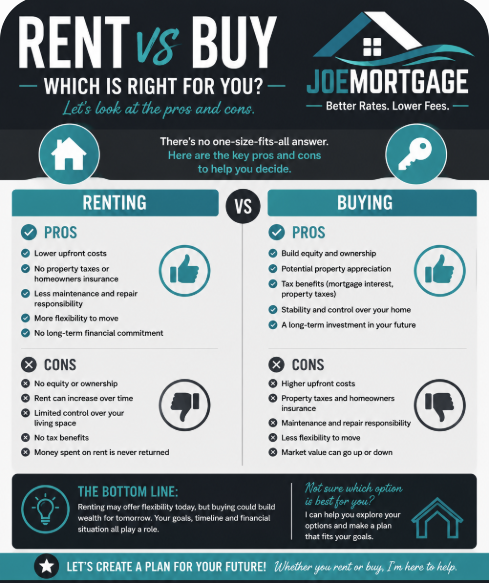
Renting vs. Buying in Peoria: The Honest Pros and Cons
Renting
✓ Advantages
- Lower upfront cost — no down payment or closing costs
- Flexibility to move without selling a property
- Maintenance and repairs are the landlord’s responsibility
- No exposure to declining home values
- Predictable costs within the lease term
✗ Disadvantages
- Zero equity accumulation — 100% of rent is an expense
- No protection against rent increases — Arizona has no rent control
- Subject to landlord decisions — lease non-renewals, sales, policy changes
- No tax benefits on rent payments
- Can’t customize or renovate the property
- Rising rents compound over time — often faster than mortgage payments
Buying
✓ Advantages
- Every payment builds equity in an asset you own
- Fixed-rate mortgage means your principal and interest never change
- Potential mortgage interest and property tax deductions
- Freedom to renovate, improve, and personalize
- Long-term inflation hedge — your payment stays flat as rents rise
- Ability to refinance if rates improve in the future
- Generational wealth transfer opportunity
✗ Disadvantages
- Larger upfront commitment — down payment and closing costs
- Responsible for all maintenance and repairs
- Less mobility — selling takes time and costs money
- Exposure to market value fluctuations
- Higher monthly cost in early years vs. renting
The Long-Term Math: Where Ownership Wins Decisively
Here’s where the rent vs. buy debate gets most interesting — and where most surface-level comparisons stop short. The monthly payment comparison is step one. The 10-year picture is where the real story lives.
Let’s use a $440,000 home purchase in Fletcher Heights with an FHA loan, 3.5% down, and a 5.25% rate — a realistic scenario for a first-time buyer in central Peoria right now. Against that, we’ll compare renting a comparable 3-bedroom home at $2,200/month with a 4% annual rent increase — which is modest by recent Arizona standards. 10-Year Comparison: Buying vs. Renting · Fletcher Heights, Peoria AZ Total rent paid over 10 years (4% annual increases, starting $2,200) $321,900 Equity remaining at end of year 10 (rent) $0 Total mortgage payments over 10 years (FHA, $2,970/mo) $356,400 Loan balance remaining after 10 years ~$378,000 Estimated home value after 10 years (conservative 3% annual appreciation) ~$591,000 Estimated equity after 10 years of ownership ~$213,000 Net financial advantage of buying over renting (10-yr) ~$178,500
Even accounting for the higher monthly payment in the early years, the 10-year buyer comes out nearly $178,000 ahead of the renter — in equity built on an asset they own. That’s the compounding power of homeownership playing out over a realistic timeline, using conservative appreciation numbers that are well below what Peoria has historically delivered.
Peoria’s median single-family price has grown at roughly 3–5% annually over the last decade, with some years significantly higher. A buyer who purchased in Fletcher Heights five years ago has seen their home appreciate meaningfully — not because they timed the market perfectly, but because they got in and held on. The Wealth-Building Reality
Renting is not inherently “throwing money away” — it provides shelter and flexibility, which have real value. But over a 10-year horizon, the financial gap between owning and renting in a market like Peoria is substantial. The renter pays $321,900 in housing costs and ends with $0 in housing equity. The buyer pays slightly more monthly but ends with roughly $213,000 in equity and a paid-down mortgage. That equity doesn’t evaporate — it can be accessed through a refinance, used as a down payment on a larger home, or passed on as part of a family’s financial legacy.
About Today’s Rates — And the Refinance Strategy Worth Understanding
One of the most common objections I hear from buyers in Peoria right now is some version of: “I want to wait until rates come down.” It’s an understandable instinct. Rates are higher today than they were in 2020 and 2021, and nobody loves paying 6% when they’ve heard stories about 3% mortgages.
Here’s the problem with waiting: home prices in Peoria haven’t been waiting. The median single-family price sits around $540,000 citywide as of mid-2026 — up despite affordability pressure. Buyers who have been waiting for rates to drop have watched the purchase price on the home they want stay flat or creep up, which often negates the benefit of a lower rate when it eventually arrives.
The more strategic way to think about this — and it’s something I discuss with buyers regularly — is what I’d call the “marry the house, date the rate” approach. You choose your home based on your long-term needs and the neighborhood you want to be in. You accept today’s rate knowing it isn’t permanent. And when rates come down — whether that’s 12 months from now or 36 months from now — you refinance. What a Refinance Could Look Like
If you buy today at 6% on a $420,000 loan and rates drop to 5% in two years, refinancing that loan produces a monthly savings of roughly $270 per month on the principal and interest payment alone. Over the remaining life of the loan, that’s over $90,000 in savings. The cost to refinance — typically $3,000 to $5,000 rolled into the new loan — breaks even in about 12 to 18 months. Meanwhile, you’ve been building equity from day one of ownership rather than contributing to your landlord’s wealth.
The math on this only works if you bought the house. It doesn’t work if you were still renting, waiting for the “perfect” rate that may or may not arrive at the exact moment you’re ready.
Refinancing is not a hypothetical backup plan — it’s a legitimate component of the ownership strategy when you buy in a higher-rate environment. I help clients run both the current-rate scenario and the refinance scenario side by side so they can see exactly what the numbers look like at different rate assumptions. Starting with a pre-approval is where that process begins.
Low Down Payment Options That Change the Equation

One of the biggest misconceptions keeping Peoria renters out of the market is the belief that you need a large down payment to buy a home. You don’t. Here’s a quick summary of what’s actually available: FHA Loans — 3.5% down: The most accessible conventional path for first-time buyers. On a $440,000 home, that’s $15,400 down. Learn more about FHA loans in Arizona. Conventional — 3% down: Available through Fannie Mae and Freddie Mac programs for buyers with stronger credit. On a $440,000 home that’s $13,200 down, though PMI will apply until you reach 20% equity. VA Loans — 0% down: For eligible veterans, active duty service members, and qualifying surviving spouses. No down payment, no PMI, and competitive rates. Full VA loan details for Peoria area buyers here.Arizona Home Plus DPA — up to 5% assistance: A down payment assistance program that pairs with a first mortgage and provides funds toward your down payment and closing costs — forgivable after 3 years in most scenarios. Learn more about Home Plus here.
The point is that the down payment barrier is far lower than most renters assume. A buyer putting 3.5% down on a $440,000 home in Fletcher Heights needs $15,400 for the down payment — not $88,000. Add in closing costs and you’re looking at roughly $20,000 to $25,000 total out of pocket in a typical scenario, portions of which can often be offset by seller concessions in today’s more balanced market.
Before you decide you “can’t afford to buy,” it’s worth having an actual conversation about the numbers. I’ve had that conversation with dozens of buyers in Peoria who were convinced they weren’t ready — and left knowing they were closer than they thought. Read my complete first-time buyer guide for Peoria for a full breakdown of the process, or check out the Arizona pre-qualification form guide to understand what lenders look at during the qualification process.
When Renting Actually Makes More Sense
I want to be honest here because I think this is where a lot of mortgage-focused content gets unbalanced: renting is genuinely the better choice in certain situations, and pretending otherwise doesn’t serve anyone. You’re planning to move within 2 to 3 years. Buying and selling within a short window is expensive — closing costs, commissions, and transaction friction eat into any appreciation. If you know you’re leaving Peoria in 24 to 36 months, renting may cost less overall. Your income or employment situation is genuinely unstable. A mortgage is a fixed obligation. If your income fluctuates significantly or you’re in a career transition, renting provides flexibility that buying doesn’t. Your credit needs work before you can get competitive terms. Buying with a 580 score is possible, but the rate premium is real. Sometimes spending 6 to 12 months building credit before buying produces a significantly better outcome over the long run. You don’t have the cash reserves for unexpected home expenses. Owning a home means owning the HVAC, the roof, the plumbing. If a $5,000 repair would wipe out your emergency fund completely, you may need a few more months of saving before buying is the right call.
Being honest about these situations is part of what makes working with an experienced broker different from talking to someone who’s simply trying to close a transaction. If you’re not ready to buy, I’ll tell you that — along with what it would take to get there and what timeline makes sense.
Ready to Run Your Specific Numbers?
Everything in this post is based on market averages. Your actual payment, your specific down payment options, and your personal rent vs. buy comparison depend on your credit, income, and the specific home you’re looking at. Give me a call and I’ll build your real picture — in about 20 minutes, with actual numbers, not estimates.(480) 239-7766 — Call JoeStart Pre-Approval →
Frequently Asked Questions
Is it cheaper to rent or buy in Peoria right now?
On a pure monthly payment basis, renting a 3-bedroom home in Peoria is currently cheaper by approximately $700 to $1,000 per month when compared to buying with a minimal down payment. However, that comparison changes significantly when you factor in equity accumulation, the compounding effect of rent increases over time, and the refinance opportunity when rates eventually decline. Over a 5 to 10-year horizon, buying typically produces a meaningfully better financial outcome for buyers who plan to stay.
Should I wait for mortgage rates to drop before buying in Peoria?
Waiting for rates to drop is a strategy that requires rates to actually drop AND home prices to stay flat or decline — neither of which is guaranteed. Peoria home prices have remained stable to modestly appreciating despite higher rates. A more reliable strategy is buying when you’re financially ready, at today’s price, and refinancing when rates improve. Every month you own is a month of equity building that renting doesn’t provide.
What is the minimum down payment to buy a home in Peoria?
It depends on your loan type. FHA requires 3.5% down with a 580+ credit score. Conventional loans start at 3% for qualified buyers. VA loans for eligible veterans require zero down payment. Down payment assistance programs like Arizona Home Plus can cover some or all of those costs through a forgivable second mortgage. On a $440,000 home, you could potentially close with $15,000 to $20,000 out of pocket — and in some cases less with seller concessions.
What are homes selling for in Desert Harbor and Fletcher Heights right now?
In the 85382 zip code — which covers the Arrowhead corridor including Fletcher Heights — the median sale price as of mid-2026 is approximately $441,000. Desert Harbor homes, which often carry a premium for established lots and lake adjacency, typically list in the $450,000 to $700,000 range depending on size and proximity to the water. Both neighborhoods offer meaningfully better value per square foot than newer master-planned communities in north Peoria.
How do I know if I’m ready to buy?
The short version: stable income, reasonable credit (580+ for FHA, 620+ for conventional), enough saved for a down payment and closing costs, and plans to stay in the area for at least 3 to 5 years. The longer version is a 20-minute conversation that looks at your actual numbers — income, credit, debts, savings — and tells you specifically what you can afford, what programs you qualify for, and whether now is the right time or whether a few months of preparation would put you in a significantly stronger position.

Helpful Resources
- Mortgage Pre-Approval in Peoria, AZ — Start Here
- First-Time Home Buyer Guide — Peoria, AZ (2026)
- FHA Loans in Arizona — Low Down Payment Options
- VA Loans in Peoria, AZ — Guide for Veterans
- Arizona Home Plus Down Payment Assistance Program
- The Complete Guide to the Arizona Pre-Qualification Form
- About Joe Hansen — Your West Valley Mortgage Broker
- CFPB — Owning a Home Resources
Joe Hansen Mortgage Loan Officer & Broker · NMLS# 217716 · AZ LO0911403
Joe Hansen is a licensed mortgage broker at Precision Mortgage in Peoria, AZ with over 20 years of experience helping West Valley buyers and homeowners navigate the mortgage process. He specializes in FHA, VA, conventional, and down payment assistance programs across Peoria, Glendale, Surprise, and the Phoenix metro area. He teaches continuing education for Arizona real estate professionals and is known for giving buyers straight answers — not sales pitches.joehansenmortgage.com(480) 239-7766Get Pre-Approved
Precision Mortgage, Inc. | 14155 N 83rd Ave Ste 125, Peoria, AZ 85381 | NMLS# 217716 | AZ LO0911403. This content is for informational purposes only and does not constitute a loan commitment or guarantee of terms. Payment examples are illustrative only and based on assumed rates of 6.00% for conventional and 5.25% for FHA and VA loans as of the date of publication; actual rates vary by borrower profile and market conditions. Rent and home price figures sourced from publicly available market data as of mid-2026. All loans subject to credit and income qualification. Contact a licensed loan officer for a personalized scenario.
