
Buying a Condo in Arizona After the 2026 Lending Changes: What Buyers and Realtors Need to Know
Buying a Condo in Arizona After the 2026 Lending Changes: What Buyers & Realtors Need to Know | Joe Hansen
Arizona Condo Financing · August 2026 Changes · Buyers & Realtors
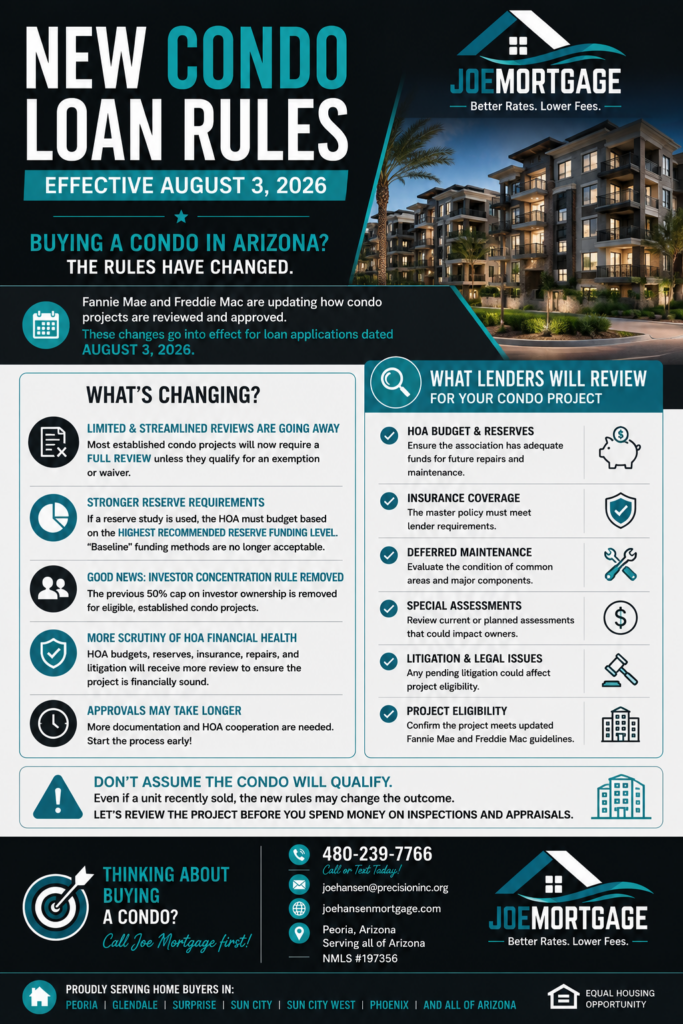
The rules for financing a condo changed significantly on August 3, 2026 — and most buyers and many agents don’t fully understand what that means yet. Here’s the honest breakdown of what changed, what it means for your purchase, and how to avoid losing a deal over a financing surprise that could have been caught early. By Joe Hansen, NMLS# 217716 · Precision Mortgage, Peoria AZ · Updated August 2026 · Effective August 3, 2026
Fannie Mae and Freddie Mac have permanently eliminated the Limited Review process for most condominium loans. Every condo in a project with more than 10 units now requires a Full Review — regardless of down payment size. If you’re buying, selling, or listing a condo in Arizona right now, this affects you.
Most buyers understand that they need to qualify for a mortgage. What a lot of people don’t realize is that the condo itself has to qualify too. The building, the HOA, the reserves, the insurance, the financials — all of it gets reviewed. And as of this summer, that review just got significantly more thorough. This guide is for buyers who want to know what they’re walking into, and for Realtors who want to set expectations correctly before a deal falls apart over a financing condition that could have been spotted in advance. Aug 3, 2026 Date Limited Review was permanently eliminated 10+ Units Any condo project this size now requires Full Review 15% New reserve funding minimum — up from 10% — effective Jan 4, 2027
What Changed on August 3, 2026?
To understand why this matters, it helps to know what existed before. For years, many established condo projects could qualify for financing through a simplified process called a Limited Review. If a buyer was putting down 10% or more on a primary residence, lenders could often approve the loan without deeply examining the HOA’s finances, reserve funding, litigation status, or insurance details. The review was fast, the paperwork was light, and transactions moved quickly.
Beginning August 3, 2026, that simplified process has been eliminated entirely. Fannie Mae officially retired the Limited Review process, and Freddie Mac simultaneously eliminated its Streamlined Review pathway. Any condominium project with more than 10 units now requires a full review — underwriters must examine the HOA’s budget, reserve accounts, outstanding litigation, and master insurance policies, regardless of how much money the buyer puts down.
Why did this happen? This is the most significant change to condo mortgage underwriting since the industry tightened standards after the Champlain Towers South collapse in Surfside, Florida in 2021. The FHFA, Fannie Mae, and Freddie Mac determined that underfunded reserves and poor HOA oversight created real structural and financial risk — and that the old limited review process wasn’t catching it. The new standards are designed to make sure every condo project backing a loan is actually financially healthy enough to maintain the building over time.
What does a Full Review now examine? Among other things:Reserve funding adequacy — Is the HOA setting aside enough money to cover major repairs and capital expenditures? The new standard is moving from 10% to 15% of the association’s operating budget, effective January 4, 2027. Current and pending litigation — Is the HOA involved in any lawsuits? Certain types of active litigation can make a project ineligible for conventional financing. Insurance coverage — Does the master insurance policy meet current requirements? Per-unit deductibles are now capped at $50,000, and lenders must verify that borrowers maintain individual HO-6 policies that fully cover the master policy’s deductible gap. Deferred maintenance and structural conditions — Are there outstanding safety or maintenance concerns affecting the building? Special assessments — Are there currently outstanding special assessments that could signal financial stress in the HOA? HOA financial statements and budget — Is the association operating on sound financial footing?
Warrantable vs. Non-Warrantable: What These Terms Actually Mean
What Makes a Condo Warrantable?
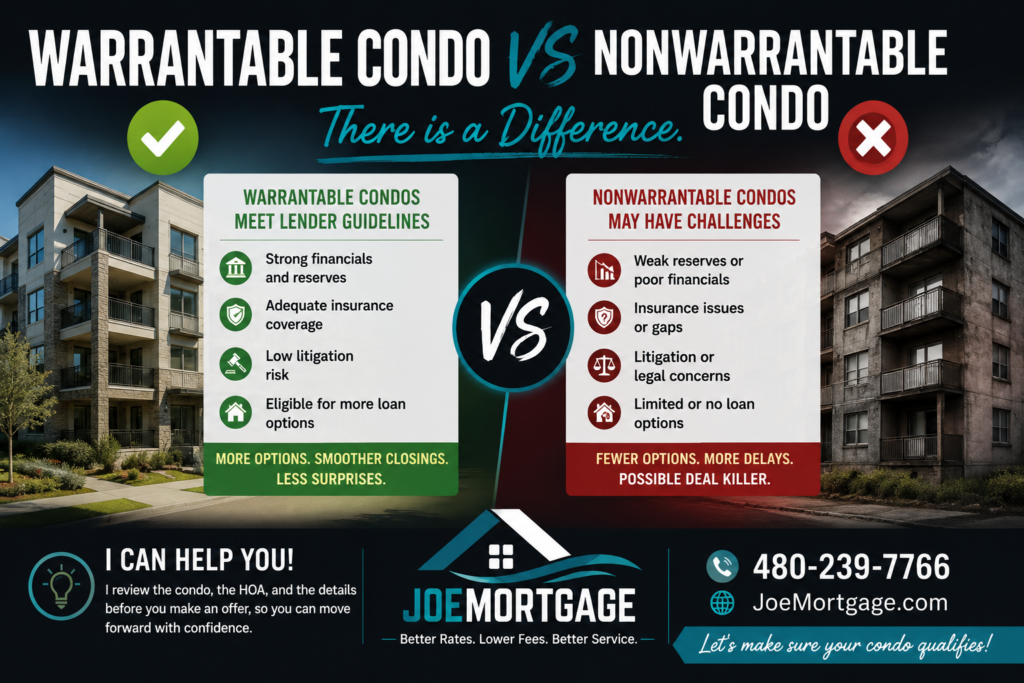
A “warrantable” condo is one that meets Fannie Mae and Freddie Mac’s project guidelines — meaning a conventional loan on a unit in that project can be sold to the secondary mortgage market. In practical terms, it means the HOA is financially healthy, the building is well-maintained, and there are no disqualifying legal or structural issues. Warrantable condos qualify for conventional financing with standard rates and down payment options.
Key characteristics that support warrantable status include:
- Adequate reserve funding (currently at least 10%, moving to 15% in January 2027)
- Current reserve study on file
- Proper master insurance coverage meeting program requirements
- No significant pending litigation against the HOA
- No major unresolved deferred maintenance or structural issues
- Appropriate owner-occupancy ratio
- No excessive commercial space within the project
What Makes a Condo Non-Warrantable?
A non-warrantable condo is one that fails to meet one or more of those agency guidelines. This does not mean the property is a bad investment or that it can’t be financed — it simply means it doesn’t qualify for conventional Fannie Mae/Freddie Mac financing. Common reasons a project becomes non-warrantable include:
- Insufficient reserve funding relative to the new standards
- Active or pending litigation against the HOA
- Insurance that doesn’t meet current requirements
- Too high a percentage of investor-owned units (in certain scenarios)
- Excessive commercial space within the building
- Developer or builder still owns a large percentage of units
- Identified structural or deferred maintenance concerns
- Outstanding special assessments indicating financial stress
Non-Warrantable Doesn’t Mean Dead
A non-warrantable designation is not necessarily the end of the transaction. Specialty portfolio lenders offer non-warrantable condo financing — these are loans held by the lender rather than sold to Fannie/Freddie. They typically require larger down payments (often 20–25%) and carry higher interest rates than conventional loans. But for buyers who genuinely want a specific property and can meet those terms, a non-warrantable loan may be a workable path. This is exactly why working with a broker who has access to multiple lenders — not just one institution’s products — matters in a condo transaction.
What This Means for Arizona Homebuyers
If you’re considering a condo purchase in Peoria, Phoenix, Scottsdale, Glendale, Mesa, Tempe, Chandler, Sun City, or anywhere else in Arizona, here’s the practical impact of these changes on your transaction: Start the HOA review process early. The Full Review requires documentation that must come from the HOA — financial statements, reserve studies, insurance certificates, and more. Some HOAs respond quickly. Others take weeks. Don’t get under contract on a condo and then discover the HOA is slow to respond or hasn’t done a current reserve study. Don’t assume a prior closing means you’re fine. Just because a unit in the same complex sold and closed with conventional financing six months ago doesn’t mean yours will. Conditions change. A reserve study may have come in unfavorably. Litigation may have been filed. Insurance may have lapsed or changed. Each transaction goes through its own review. Build extra time into your contract. The Full Review takes more time than the old limited process. A 30-day closing on a condo purchase is tight under the new standards. Build in 45 days or more whenever possible. Know your backup options before you need them. If conventional financing falls through on the condo, understanding whether FHA approval exists, whether a spot approval is possible, or whether non-warrantable portfolio financing is available — before you’re in crisis mode — saves deals.
What Realtors in Arizona Need to Know Right Now

I work with agents across the West Valley regularly, and condo transactions are where I see the most preventable surprises. Here’s what the most prepared agents I work with are already doing differently: Ask for HOA documents before your buyer falls in love. Request the current financials, reserve study, and a summary of any pending litigation as early as possible — ideally before writing an offer. Sellers and listing agents often have these readily available. If they don’t, that’s worth noting before you write an offer your buyer can’t close. Know whether the property is actually a condo — more on this below, but many properties listed as townhomes, patio homes, or villas in Arizona are legally condominiums subject to condo financing requirements. The MLS description is not the legal determination. Encourage pre-approval before condo showings. A buyer who is pre-approved knows their loan program, their qualifying criteria, and any program-specific condo requirements before they fall in love with a unit that turns out to have an FHA-approved project requirement their credit profile needs. Don’t promise the financing will work because a neighbor’s unit closed. Each transaction gets reviewed independently under the new Full Review standards. Prior closings are not guarantees. Loop in your mortgage broker early on any condo deal. A quick call before your client makes an offer can identify whether the project has known issues — FHA approval status, recent reserve study concerns, litigation history — that could affect financing. That call takes 10 minutes and can save a 30-day transaction.
FHA Condo Financing: A Path Many Buyers Don’t Know About
One of the most persistent misconceptions I hear from first-time buyers is that FHA loans can’t be used on condos. That is not accurate. FHA absolutely finances condos — but the project must either be on HUD’s approved condo list or qualify through what’s called a spot approval.
The FHA-approved condo list is publicly searchable at the official HUD condo lookup tool:
FHA Condo Approval Search: entp.hud.gov/idapp/html/condlook.cfm
A word of caution: appearing on the list isn’t enough on its own. FHA condo approvals expire — they’re typically valid for three years and must be renewed. A project can be on the list but have an expired approval that renders it ineligible. Always verify the current status and expiration date through the lookup tool, not just through a listing agent’s claim that “it’s FHA approved.”
What Is an FHA Spot Approval?
Even if a condo project isn’t on HUD’s approved list, individual units can sometimes be approved through a Single Unit Approval — commonly called a spot approval. This allows FHA financing on a single unit without requiring the entire project to go through the full FHA approval process. Not every project qualifies for spot approval, and there are specific criteria the project must meet, but it’s a legitimate and often helpful tool for Arizona buyers looking at condos in projects that haven’t pursued full FHA approval. FHA’s Advantage for First-Time Condo Buyers

FHA loans allow down payments as low as 3.5% with a 580+ credit score — a meaningful advantage for buyers who haven’t built up large savings. In communities across Peoria, Phoenix, Glendale, and the West Valley where condo prices are often more accessible than single-family homes, FHA condo financing can be the bridge that makes homeownership possible. It requires more documentation and the project must qualify, but it’s a real path worth exploring before assuming it’s off the table.
Condo vs. Townhouse in Arizona: The Difference That Can Derail Your Financing
This is one of the most practically important sections in this entire guide — and one that trips up buyers and agents alike in Arizona regularly.
In everyday conversation, “townhouse” describes a style of home: typically two stories, shared walls, limited yard. “Condo” is commonly used the same way. But in the world of mortgage financing, what matters isn’t the style of the building — it’s the legal ownership structure of the property.
A property that looks like a townhouse on the outside can be legally organized as a condominium — and if it is, it’s subject to all of the condo financing requirements described in this article. On the other hand, a property that looks like a condo can be organized as a fee simple property (where you own the land under it) with no condo financing requirements at all. The Arizona MLS Problem
In Arizona, it is common — genuinely very common — to see properties listed in the MLS as “townhouse,” “townhome,” “patio home,” “villa,” or “cluster home” when the property is legally a condominium subject to condo financing guidelines. This isn’t always intentional misrepresentation — agents often list based on the style of the home rather than the legal ownership structure. But the legal structure is what controls financing, not the MLS description.
How to Identify a Condo in Arizona: Look for “Horizontal Property Regime”
Here’s the most useful thing I can tell Arizona buyers and agents about identifying condominiums: if you see the phrase “Horizontal Property Regime,” “Horizontal Property,” or “Horizontal Regime” in the public records, the property is almost certainly legally a condominium. Arizona condominiums are governed by the Arizona Horizontal Property Act and organized through a Condominium Plat or Condominium Declaration filed with the county recorder.
I can look this up in the public records as part of any pre-approval review — before you make an offer and before you find out through a financing contingency that the property you thought was a townhouse is actually a condo requiring a full HOA project review. This kind of early verification has saved deals in Peoria, Glendale, and across the West Valley more times than I can count. The Simple Rule
Don’t rely on the MLS property type field. Don’t rely on what the listing agent calls it. If you’re buying in Arizona and you’re not sure whether the property is a condo or fee simple, ask your mortgage broker to check the public record before you write an offer. It takes minutes and the answer changes the entire financing conversation.
What Happens If the Condo Doesn’t Pass?
A condo project that doesn’t qualify for conventional financing is a problem — but it’s not automatically a deal-killer. Here are the options, in order of what I typically explore: Options That May Save the Deal
- Switch to FHA financing if the project is on the approved list or qualifies for a spot approval
- Switch lenders — different lenders sometimes have different overlays on what they’ll accept
- Seller or HOA provides missing documentation that resolves the disqualifying issue
- HOA addresses the specific deficiency (updated reserve study, corrected insurance)
- Non-warrantable portfolio loan — higher rate and down payment, but a real path
- Negotiate a contract extension to allow time for the HOA to respond
When It May Be a Hard Stop
- Active litigation that disqualifies the project under all agency programs
- Severe structural or safety concerns identified in the project review
- HOA unwilling or unable to provide required documentation
- Reserves so inadequate that no lender is willing to take the risk
- Buyer’s financial profile doesn’t support non-warrantable financing terms
The key message here is: don’t panic until you’ve actually explored all the paths. I’ve helped buyers work through condo financing issues that initially looked fatal — by switching programs, switching lenders, or helping coordinate the HOA documentation — and close successfully. What’s most important is knowing early, which means verifying before you’re under contract whenever possible.
How I Help Arizona Buyers and Realtors Navigate Condo Transactions
As the #1 ranked mortgage broker in Peoria for 2026 and a broker with access to multiple lenders rather than a single institution’s products, I approach condo transactions differently than a bank loan officer can.

Before you make an offer, I can check the public records to verify the legal ownership structure, check whether the project has FHA approval and whether it’s current, review any available HOA documentation for obvious red flags, identify whether a spot approval might be viable, and tell you which loan programs are most likely to work for both you and this specific project.
After you’re under contract, I can coordinate the full project review documentation, work with multiple lenders if one lender’s condo overlays are more restrictive than another’s, and identify alternative programs quickly if the primary path hits an obstacle.
For Realtors: I’m happy to do a quick condo review on any listing you’re considering showing to a pre-approved buyer — just send me the address. The goal is the same for all of us: get to closing without surprises.
Learn more about how I work with buyers across the West Valley here.
Looking at a Condo in Arizona? Let’s Check It Before You Offer.
A 10-minute conversation before you write an offer can tell you whether the project has known financing issues, whether FHA approval is current, and whether the property is legally a condo or fee simple. That’s information worth having before you’re under contract.(480) 239-7766 — Call JoeAbout Joe Hansen →
Frequently Asked Questions
Q: Can condos still be financed after August 3, 2026?
Yes — absolutely. The change eliminated the simplified Limited Review process, not condo financing itself. Condos that meet the Full Review requirements are fully eligible for conventional financing. FHA-approved condos continue to qualify for FHA loans. Non-warrantable condos have specialty financing options. The bar is higher, but condo financing is alive and well.
Q: What is the difference between a warrantable and non-warrantable condo?
A warrantable condo meets Fannie Mae and Freddie Mac’s project guidelines — healthy reserves, proper insurance, no disqualifying litigation, and so on — and qualifies for conventional financing. A non-warrantable condo fails one or more of those guidelines and cannot be financed with a conventional loan. Non-warrantable doesn’t mean the property is bad — it means it doesn’t fit the agency guidelines, and specialty portfolio financing may be needed instead.
Q: Can I buy a condo with FHA financing?
Yes. FHA loans are available for condos in projects that are on HUD’s approved list (searchable at HUD’s condo lookup tool) or that qualify through a Single Unit (spot) Approval. FHA approval is separate from conventional warrantability — a project can be FHA-approved but not conventionally warrantable, or vice versa. Always verify the current approval status, as approvals can expire.
Q: What is an FHA spot approval?
A spot approval — officially called a Single Unit Approval — allows FHA financing on an individual condo unit without requiring the entire project to go through full FHA project approval. The unit and project must still meet certain eligibility criteria, and not every project qualifies. But it’s a helpful option for Arizona buyers looking at condos in unapproved or recently-expired projects.
Q: Is a townhouse the same as a condo for financing purposes?
Not necessarily — and this is one of the most important things Arizona buyers need to understand. “Townhouse” is a style description. “Condo” is a legal ownership structure. A property that looks exactly like a townhouse can be legally organized as a condominium and subject to all condo financing requirements. In Arizona, if you see “Horizontal Property Regime” in the public records, it’s almost certainly a condominium. I can check this for any property before you make an offer.
Q: What does “Horizontal Property Regime” mean in Arizona?
It’s the legal term used in Arizona for a condominium ownership structure. Arizona condominiums are governed by the Arizona Horizontal Property Act. When you see “Horizontal Property Regime,” “Horizontal Regime,” or “Horizontal Property” in a title report or public record, the property is being treated as a condominium — meaning condo financing guidelines apply, regardless of how it’s marketed or described in the MLS.
Q: What if the condo project fails the review after I’m already under contract?
You have options — but time matters. Depending on why it failed, you may be able to switch to FHA if the project is approved, switch lenders who have different overlays, work with the HOA to provide missing documentation, seek non-warrantable portfolio financing, negotiate a contract extension, or — in some cases — exercise your financing contingency to exit the contract. This is exactly when having an experienced broker who knows all the available paths is most valuable.
Q: Can I put 3% down on a condo?
Yes — for a warrantable conventional condo, 3% down programs are available for qualifying buyers. FHA allows 3.5% down on FHA-approved condos. The condo project still has to qualify under the applicable review standard, but the down payment options for condos are the same as for single-family homes on eligible projects.
Q: Do 55+ and retirement community condos face the same requirements?
Yes — condo financing guidelines apply regardless of whether the community is age-restricted. Communities in Sun City, Sun City West, and other active adult developments across Arizona that are legally organized as condominiums are subject to the same Full Review requirements as any other condo project. The age restriction doesn’t change the ownership structure or the financing requirements.
Q: Should I avoid buying a condo because of these changes?
No. Condos remain excellent housing options for many buyers — often more affordable, lower maintenance, and in desirable locations across the Phoenix metro. The 2026 changes raise the bar for what documentation is required, but they don’t eliminate condo financing. The right approach is to verify early, work with a broker who understands the requirements, and know your backup options if the primary path hits a snag. That’s different from avoiding condos altogether.
Helpful Resources
- HUD FHA Condo Approval Search — Check Project Status
- FHA Loans in Arizona — Complete Guide
- First-Time Homebuyer Guide — Peoria, AZ (2026)
- #1 Mortgage Broker in Peoria for 2026 — Joe Hansen
- About Joe Hansen — West Valley Mortgage Broker
- Arizona Horizontal Property Act — ARS Title 33
Joe Hansen Mortgage Loan Officer & Broker · NMLS# 217716 · AZ LO0911403
Joe Hansen is a licensed mortgage broker at Precision Mortgage in Peoria, AZ — named the #1 Mortgage Broker in Peoria for 2026. With over 20 years of experience in the Arizona mortgage market, he helps buyers, first-time homeowners, and real estate professionals navigate complex transactions, including condo financing across Peoria, Glendale, Phoenix, Surprise, Scottsdale, Sun City, and the greater West Valley.joehansenmortgage.com(480) 239-7766About Joe
Precision Mortgage, Inc. | 14155 N 83rd Ave Ste 125, Peoria, AZ 85381 | NMLS# 217716 | AZ LO0911403. This content is for informational purposes only and does not constitute a loan commitment or guarantee of terms. Condo project eligibility, FHA approval status, and financing options vary by project, lender, and transaction. Program guidelines are subject to change. References to Fannie Mae, Freddie Mac, and FHA guidelines are based on publicly available information as of the date of publication. Contact a licensed loan officer for a current assessment of a specific property or transaction.
