Moving to Arizona in 2027? 10 Things to Know Before Buying in Peoria, Glendale, Surprise or Sun City
By Joe Hansen, Mortgage Loan Officer, Peoria, AZ · Updated October 12, 2026
Yes, you can buy a home in Arizona before you move here, and plenty of people do. The loan approval usually isn’t what trips people up. It’s everything around it: a monthly payment that includes much more than principal and interest, insurance and HOA costs that change from street to street, and picking a city from listing photos instead of from a real commute.
I’m Joe Hansen, a mortgage broker in Peoria with more than 24 years of Arizona lending experience, and I’ve taught continuing education on credit to Arizona realtors for over ten years. BusinessRate named me the #1 mortgage broker in Peoria for 2026, but what matters more for you is that I spend my days helping buyers in Peoria, Glendale, Surprise and Sun City. This guide covers what I’d want you to know before you book the flight.
Where are people moving to Arizona from?

California is still the biggest source by a wide margin. Common Sense Institute Arizona, working from Census data, found that about one in five people who moved into Arizona in 2023 came from California, and California accounted for more than half of the state’s net domestic migration that year. The same research points to Washington, Texas, Colorado and North Carolina as steady sources of newcomers.
Arizona remains near the top nationally, too. A StorageCafe analysis of Census data ranked it fourth in the country for net domestic migration, with roughly 51,000 more people arriving than leaving in 2024. That analysis also found that about 46% of newcomers buy a home within their first year here, which is exactly why it pays to sort out the financing side early.
Price is a big part of the pull. By some estimates, Arizona home prices run 40% to 45% lower than California’s. If you’re coming from the Pacific Northwest, Colorado or the Midwest, the gap will look different, and in every case the price on a listing is only part of what you’ll pay each month. That’s what the rest of this guide is about.
1. Arizona isn’t one housing market
Phoenix, the West Valley, the East Valley, Tucson, Prescott and Flagstaff are very different places to live. Prices, lot sizes, commute times, summer heat and everyday lifestyle all change as you move around the state. Prescott and Flagstaff sit at higher elevations and feel noticeably cooler than the Phoenix area. Tucson has its own pace and its own price points.
Even inside the West Valley, Peoria, Glendale, Surprise and Sun City are four different places, and I’ll walk through each of them in section 9. The point for now: don’t treat “Arizona” as a single market with a single price.
2. Know the true monthly payment, not just the price
Two homes with the same list price can have monthly payments that are hundreds of dollars apart. Lenders qualify you on the full payment, and so should you.
| Payment piece | What drives it |
|---|---|
| Principal and interest | Loan amount, interest rate and loan term |
| Property taxes | The specific property and its taxing districts (see section 3) |
| Homeowners insurance | Roof age, pool, claims history, home construction (see section 4) |
| HOA dues | The community and what it provides (see section 5) |
| Mortgage insurance | Down payment size and loan type, when it applies |
Your loan type changes that math. A conventional loan in Peoria can drop the mortgage insurance once you build enough equity, while an FHA loan can be a good fit if you have a smaller down payment or a credit profile that’s still being built. Loan limits matter too. For 2026, the Maricopa County one-unit limits are $832,750 for conventional and $557,750 for FHA. FHFA and HUD reset those limits each January, so the numbers will likely change for 2027.
3. Arizona property taxes are low, but they’re not the whole picture
If you’re coming from California, Illinois, New Jersey or Texas, Arizona property taxes will probably feel light. Median effective rates in Maricopa County come in at roughly 0.4% to 0.5% of home value. On a $500,000 home, that’s often in the neighborhood of $2,000 to $2,500 a year, compared with around 1% of the purchase price or more in California.
A few things help explain why. On owner-occupied homes, Arizona caps the primary property tax rate at 1% of the home’s limited property value, and the limited property value generally can’t grow more than 5% a year. Owner-occupied homes also get a rebate on school taxes. But a few cautions are worth knowing:
- Your limited property value won’t necessarily reset to your purchase price, so the first bill can look different from what you expect.
- Secondary taxes, such as voter-approved bonds and overrides, are calculated separately.
- Some newer communities carry special assessments, such as a community facilities district. Ask about this on every new-build lot.
Look up the exact parcel on the Maricopa County Assessor’s website and put the real number in your payment estimate.
4. Homeowners insurance matters more than most buyers expect
Insurance is the cost I see surprise people most. The price and the availability of coverage can vary based on roof age, whether there’s a pool, the home’s construction, and any prior claims. Many carriers get picky about older roofs, and Arizona’s monsoon season brings wind and hail that insurers pay attention to.
My advice is to get an insurance quote on the specific home early, before you’re deep into the transaction. The premium goes straight into your monthly payment, which affects how much you can borrow, and your lender will need proof of coverage before closing anyway. Learning that a roof is a problem in week one is far better than learning it in week three.
5. HOAs are extremely common
Most newer West Valley communities have a homeowners association, and many established neighborhoods do as well. Before you fall for a house, find out:
- The monthly or quarterly dues, and what they cover
- Transfer fees and any one-time setup or capital contribution at closing
- Rules on rentals, parking, RVs, landscaping and exterior changes
- Whether there are extra club, golf or recreation fees on top of the dues
HOA dues count toward your monthly obligations when a lender calculates your qualifying ratios, so they affect how much house you can afford. Arizona contracts give you time to review the HOA documents. Use it, and read the rules, not just the dues.
6. New construction or resale? It’s a bigger decision than it looks
The West Valley, and Surprise in particular, has a lot of new construction. Builders often advertise incentives such as closing cost credits, upgrades, and rate buydowns that are tied to using their preferred lender. Some of those offers are genuinely good. Others are less impressive once you add up the lot premiums, upgrade costs and a higher price than a comparable resale.
My suggestion is to treat the builder’s lender like any other bid. Get a Loan Estimate from them and one from an outside lender, then compare the total cost of the deal, not just the headline rate. If you’re looking at new homes in Surprise, a local mortgage broker in Surprise, AZ can run that comparison with you before you sign anything. Ask also about the closing timeline, because you may be locking a rate months before the home is finished.
7. You may be able to buy before you actually move

This is where my own work comes in, because it’s the question I hear most from out-of-state buyers. You can qualify for an Arizona mortgage while you still live somewhere else. Here are the common situations:
- Job transfer or new job: lenders will generally want to see an offer letter or employment verification and your start date. The exact documentation depends on the loan program and the lender.
- Remote work: documented, stable remote income qualifies like any other income, and your location doesn’t change that.
- Retirement income: Social Security, pensions and retirement account distributions can count when they’re properly documented.
There is one important catch. A primary-residence loan expects you to actually live in the home, generally moving in within about 60 days of closing. If your move is much further out, we should talk about the timing before you make an offer, because a second-home loan has different rules, rates and down payment requirements.
If you’re a veteran or active-duty service member relocating here, read the complete guide to VA loans in Surprise. The VA benefits work across the West Valley, and eligible borrowers may be able to buy with no down payment.
8. What happens to your current house matters
If you own a home now, what you do with it shapes your Arizona purchase. There are three common paths:
- Sell first. This is the cleanest path. You’ll know how much cash you have for a down payment, and you won’t carry two payments. The downside is a possible gap if you need a place to live between closings.
- Keep it as a rental. Lenders can often count a portion of the rental income, typically around 75% of the lease amount, but it requires documentation, and you’ll usually need reserves. Your old mortgage payment still counts against you if the rent doesn’t cover it.
- Buy first, sell later. This can work, but you’d be qualifying with both payments in the picture, and a contingent offer is less competitive in a busy market.
Each of these affects your available cash, your reserves and your qualifying ratios, so decide on your plan before you start touring homes. I’d rather walk through the options with you early than watch a good house slip away because the numbers weren’t ready.
9. Choose the area based on more than the house
A great house in the wrong spot gets old fast. Think about your commute (the Loop 101, Loop 303, Grand Avenue and Bell Road all matter in the West Valley), schools, freeway access, nearby recreation, shopping and how much new development is coming. Here’s how the four cities I work in compare.
Peoria
Peoria covers a lot of ground, from older neighborhoods near Grand Avenue to newer master-planned communities in the north. Lake Pleasant is on the northwest side, and the Peoria Sports Complex hosts spring training for the Mariners and the Padres. It’s a good fit if you want a mix of established neighborhoods, newer homes and outdoor recreation in one city.
Glendale
Glendale is large and varied. You’ll find the Arrowhead Ranch area in the north, the Camelback Ranch area near the spring training complex, and the Westgate entertainment district close to State Farm Stadium. Luke Air Force Base is on the West Valley’s western edge, which makes Glendale and the surrounding area popular with military families. Prices and neighborhood character vary quite a bit from one part of the city to another, so compare specific neighborhoods, not just the city name.
Surprise
Surprise has some of the most new construction in the Valley, with communities such as Marley Park and Rancho Gabriela, and Surprise Stadium hosts spring training for the Royals and the Rangers. If you want a newer home and a planned community, this is often where buyers start. Just budget for HOA dues and ask about special assessments on new lots.
Sun City
Sun City, Sun City West and Sun City Grand (which is in Surprise) are age-restricted communities built around golf, recreation centers and an active social calendar. If you’re 55 or older and looking for that lifestyle, ask about the age rules, recreation fees and what the dues cover. Buyers 62 and older sometimes also look at a reverse mortgage for purchase. It isn’t right for everyone, and I’ll tell you honestly whether it fits your situation.
10. Get prequalified before you come house hunting
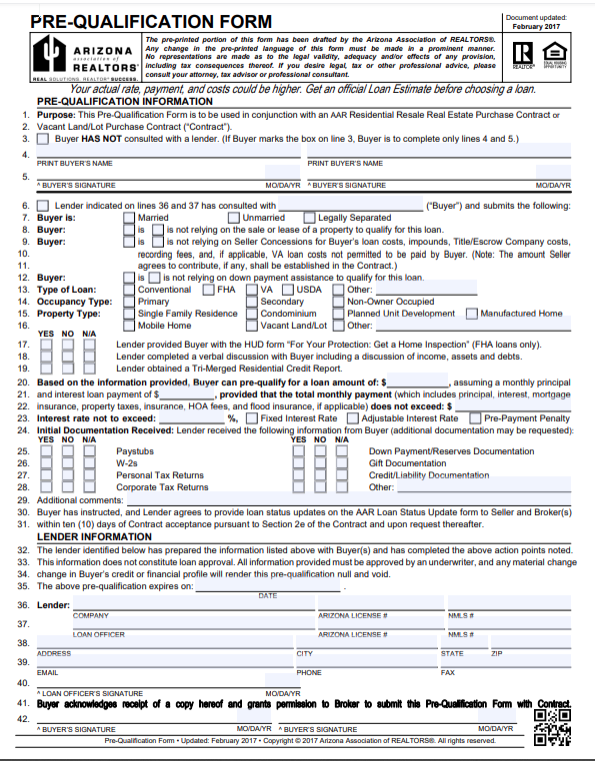
If you’re flying in for a weekend of tours, you don’t want to spend the first day figuring out what you can afford. Before the trip, we can work out your payment range, your cash to close, and what documents you’ll need, so you walk into each home knowing whether it works. Since about 46% of newcomers buy within their first year, a prequalification letter also helps you move quickly when the right house shows up.
If you’re still deciding on timing, I wrote about whether to buy a house in Peoria now or wait until 2027, and that may help you decide whether to start the process this fall or later.
Frequently asked questions
Can I buy a house in Arizona before I move there?
Yes. Buyers do it every year, usually with a job transfer, a remote job, or retirement income. For a primary-residence loan, lenders generally expect you to move in within about 60 days of closing, so the timing of your move matters. Talk to a lender before you write an offer so the plan fits the loan program.How much are property taxes in Peoria, Glendale and Surprise?
Arizona’s property taxes are low compared with many states. Median effective rates in Maricopa County come in at roughly 0.4% to 0.5% of home value, though your actual bill depends on the specific property, its school and fire districts, and any special assessments. Always check the parcel on the Maricopa County Assessor’s site before you buy.How much down payment do I need to buy in Arizona?
It depends on the loan. FHA loans allow as little as 3.5% down for qualified borrowers, some conventional programs go as low as 3% down, and eligible veterans may be able to buy with no down payment through a VA loan. Arizona also has down payment assistance programs that can help with the upfront cash.Should I use the builder’s preferred lender?
You can, but compare before you commit. Builder incentives are real and sometimes the best deal on the table. Get a Loan Estimate from the builder’s lender and one from an outside lender, then compare the full cost: rate, fees, closing credits and any price changes tied to using the preferred lender.Is Sun City only for retirees?
Sun City is an age-restricted community, so there are age rules for residents, generally requiring at least one occupant to be 55 or older. The details differ between Sun City, Sun City West and Sun City Grand, so confirm the current rules with the community before you make an offer.Do I need a local lender if I’m still living in another state?
Your home will be in Arizona, so it helps to work with a lender who is licensed in Arizona and knows how local contracts, appraisals, HOAs and builders work. Most of the process, including applications and document collection, can be handled remotely.
Planning a move to Arizona? Let’s run your numbers first.
Call me before your trip and we’ll work out your payment range, your cash to close and the best loan for your situation.Call Joe at 480-239-7766
Where the numbers come from: Migration figures are from Common Sense Institute Arizona (2023 Census data) and a StorageCafe analysis of Census data reported by the Phoenix Business Journal (April 2026). Loan limits are from FHFA and HUD for 2026. Property tax rates are median effective rates and vary by property.
This article is for general information and isn’t a commitment to lend or tax, legal or insurance advice. Rates, loan limits, program rules and costs change, so confirm current details before you make a decision.
