
2-1 Buydown vs. Permanent Rate Buydown in Arizona: Which One Actually Saves You More?
Mortgage Strategy · Peoria & Phoenix, AZ · 2026 2-1 Buydown vs. Permanent Rate Buydown in Arizona: Which One Actually Saves You More? | Joe Hansen
When a seller is offering concessions on your Arizona home purchase, how you use that money can change your payment significantly — both now and over the long haul. Here’s the honest, detailed breakdown of how each option works and how to decide which one fits your situation. By Joe Hansen, NMLS# 217716 · Precision Mortgage, Peoria AZ · Updated 2026
This is a question I get regularly from buyers across the Phoenix metro area, and it’s one that deserves a real answer — not a slogan. When a seller agrees to contribute money toward your closing costs, you suddenly have options: use those funds for a temporary rate buydown that lowers your payment for the first year or two, or use them to permanently buy down your interest rate for the life of the loan. Both have real value. Which one wins depends entirely on your specific situation, how long you plan to keep the loan, and whether refinancing is a realistic scenario in your future.
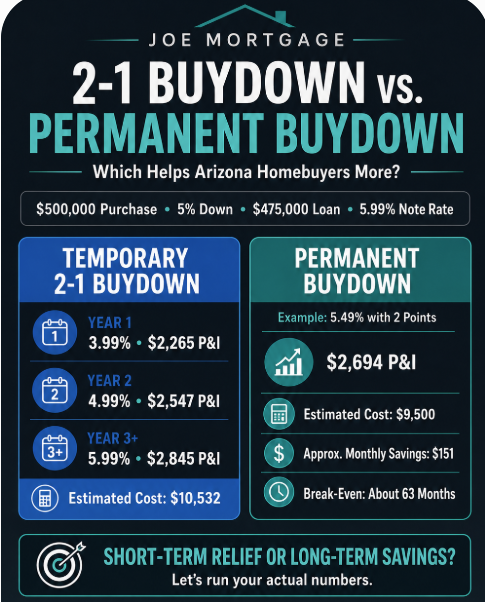
As the #1 ranked mortgage broker in Peoria for 2026, I run these comparisons for buyers regularly. Let me show you exactly how each option works — using a realistic Arizona purchase scenario — so you can make this decision with full information. $10,532 Estimated cost of a 2-1 buydown on a $475,000 loan $580/mo Year-one monthly payment savings with a 2-1 buydown 63 months Typical break-even on a 2-point permanent buydown
The Arizona Purchase Scenario We’re Working With
To keep this grounded in reality, every example below uses the same baseline: Base Scenario — Arizona Home Purchase Purchase Price $500,000 Down Payment 5% ($25,000) Loan Amount $475,000 Loan Term 30-year fixed Note Rate 5.99% Full P&I Payment at Note Rate ~$2,845/month
All payments in this post are principal and interest only. Property taxes, homeowners insurance, mortgage insurance, and HOA dues are additional and vary by property. Now let’s look at each buydown option in detail. Important — What a Buydown Is Not
A temporary buydown does not change your actual mortgage rate. Your loan closes at 5.99% and stays at 5.99%. The seller deposits money into a separate buydown account at closing, and those funds are released monthly to cover the difference between your reduced payment and your full payment. Understanding this distinction matters — especially for buyers who assume a lower first-year payment means a lower permanent rate.
Temporary Buydowns Explained: 1-0, 2-1, and 3-2-1
The 1-0 Buydown
The simplest version. Your payment is calculated at 1% below the note rate for the first year only. Starting in year two, you make the full payment based on your actual note rate. 1-0 Buydown · $475,000 Loan · 5.99% Note Rate Year 1 payment rate 4.99% Year 1 monthly P&I ~$2,547 Monthly savings vs. full payment ~$298/month Year 2+ payment ~$2,845 (full note rate) Total buydown cost ~$3,574
The 2-1 Buydown
The most commonly negotiated option in Arizona right now. You get a larger reduction in year one and a smaller reduction in year two, before stepping up to the full note-rate payment in year three.
| Period | Payment Rate | Approx. P&I | Monthly Assistance |
|---|---|---|---|
| Year One | 3.99% | ~$2,265 | $580/month |
| Year Two | 4.99% | ~$2,547 | $298/month |
| Year Three+ | 5.99% (note rate) | ~$2,845 | $0 |
2-1 Buydown Total Cost Breakdown Year-one assistance ($580 × 12) $6,958 Year-two assistance ($298 × 12) $3,574 Total 2-1 buydown cost ~$10,532
The 3-2-1 Buydown
The most aggressive option — and the most expensive. It extends temporary payment assistance over three years and creates the lowest possible first-year payment. The catch: its cost often exceeds what seller concession limits allow on a conventional loan with a small down payment.
| Period | Payment Rate | Approx. P&I | Monthly Assistance |
|---|---|---|---|
| Year One | 2.99% | ~$2,000 | $845/month |
| Year Two | 3.99% | ~$2,265 | $580/month |
| Year Three | 4.99% | ~$2,547 | $298/month |
| Year Four+ | 5.99% (note rate) | ~$2,845 | $0 |
Total estimated cost: approximately $20,669. The 3-2-1 Concession Limit Problem
On a conventional loan with 5% down, seller concessions are generally capped at 3% of the purchase price — $15,000 on a $500,000 home. The 3-2-1 buydown costs approximately $20,669, which exceeds that cap. In this scenario, the seller cannot fund the entire 3-2-1 buydown, and the buyer would need to cover the difference. This is exactly why I always check the concession limits against the actual buydown cost before a buyer makes an offer in Arizona — the program has to fit within what’s actually permitted.
All Three Temporary Options — Side by Side
| Option | Year-One P&I | Total Cost | Full Payment Begins |
|---|---|---|---|
| No buydown | $2,845 | $0 | Immediately |
| 1-0 buydown | $2,547 | $3,574 | Year 2 |
| 2-1 buydown | $2,265 | $10,532 | Year 3 |
| 3-2-1 buydown | $2,000 | $20,669 | Year 4 |
Permanent Rate Buydown: What Discount Points Actually Do
A permanent rate buydown uses mortgage discount points to reduce your note rate for the entire life of the loan. One point equals 1% of the loan amount — on this $475,000 loan, one point costs $4,750.
Here’s where buyers get tripped up: one point does not automatically equal a specific rate reduction. How much rate you get per point depends entirely on the lender’s pricing when you lock. It changes daily, varies by loan program, credit score, down payment, and other factors. The only way to know the real number is to pull actual pricing on the day you lock. That said, here’s a realistic illustration:
| Option | Points Cost | Approx. Rate | Monthly P&I | Monthly Savings |
|---|---|---|---|---|
| No points | $0 | 5.99% | $2,845 | — |
| 1 point | $4,750 | 5.74% | $2,769 | ~$76/month |
| 2 points | $9,500 | 5.49% | $2,694 | ~$151/month |
These are illustrative examples only — not a rate quote. Actual pricing must be verified on the day you lock. Here’s more on how I shop rates across multiple lenders for Peoria area buyers.
The Break-Even Calculation — The Number That Matters Most
With a permanent buydown, the break-even point tells you how long you need to keep the original mortgage before the monthly savings recover the upfront cost. The formula is simple:
Cost of buydown ÷ monthly savings = break-even months Break-Even Analysis · 2-Point Permanent Buydown Cost of two discount points $9,500 Monthly savings vs. no-points rate ~$151/month Break-even period ~63 months (5.25 years) If you keep the loan 10 years ~$18,120 in total savings If you keep the loan 30 years ~$54,360 in total savings
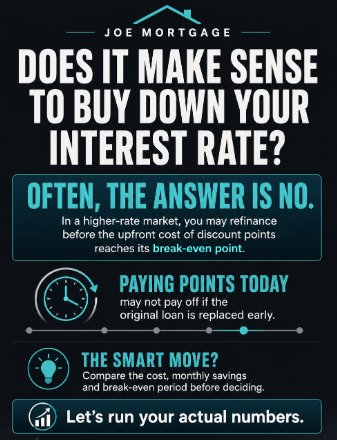
A permanent buydown only works in your favor if you keep the original mortgage long enough to reach — and pass — that break-even point. If you sell or refinance before month 63, you haven’t recovered the cost of the points. The savings simply stop when the original loan is paid off.
The Direct Comparison: 2-1 Buydown vs. Two-Point Permanent Buydown
This is the comparison most Arizona buyers are actually trying to make. The 2-1 buydown and a two-point permanent buydown have similar upfront costs in this scenario — making it a genuine apples-to-apples decision.
| Comparison Point | 2-1 Buydown | 2-Point Permanent |
|---|---|---|
| Upfront cost | ~$10,532 | $9,500 |
| Year-one monthly savings | $580/month | $151/month |
| Year-two monthly savings | $298/month | $151/month |
| Year-three+ monthly savings | $0 — full rate kicks in | $151/month — forever |
| Total savings after 2 years | ~$10,532 | ~$3,624 |
| Total savings after 10 years | ~$10,532 (no more after yr 2) | ~$18,120 |
| If you refinance in year 1–2 | Unused funds credited at payoff | Unrecovered points — lost |
The Honest Bottom Line
The 2-1 buydown wins in the short term — by a lot. In the first two years, you receive approximately $10,532 in total payment relief vs. roughly $3,624 from the permanent buydown. That’s meaningful monthly cash flow during the period when buyers often have the most financial pressure.
The permanent buydown wins in the long run — if you keep the loan. After the 2-1 buydown ends in year three, the permanent buydown keeps delivering $151 per month every month. Over a 30-year loan, that accumulates to over $54,000 in total savings. The crossover point — where the permanent buydown has delivered more cumulative value — typically occurs around years 4 to 5 depending on the specific pricing.
The Refinance Variable: What Happens If Rates Drop?
One of the most common reasons Arizona buyers choose a 2-1 buydown over permanent points is the expectation that rates may drop within a year or two — creating the opportunity to refinance and permanently lower the rate without having paid for points on the original loan.
in a high interest rate market?
That can be a sound strategy. But it has to be approached honestly. Refinancing is never guaranteed. A future refinance will depend on rates available at that time, your credit, income, employment, the property’s value, available equity, loan program requirements, and the cost of refinancing itself. If rates don’t come down the way you’re hoping, you must be able to comfortably afford the full 5.99% note-rate payment starting in year three. A 2-1 Buydown Should Provide Flexibility — Not Mask an Unaffordable Payment
I’ve seen buyers stretch into homes using a 2-1 buydown, with the full intent of refinancing before year three — and then refinancing didn’t happen because rates moved the wrong way. The payment step-up in year three became a real financial stress point. A temporary buydown is a legitimate tool. But every buyer needs to be fully prepared to make the full note-rate payment if the refinance doesn’t materialize.
What Happens to Unused Buydown Funds If You Refinance?
This is one of the best features of a temporary buydown that most buyers don’t know about. If you refinance during the buydown period — say, after 12 months — the original mortgage is paid off before all the buydown funds have been used. For conventional loans, the remaining buydown funds are generally credited toward the payoff of the original mortgage, reducing what you owe at closing. For VA loans, remaining funds must be applied to the outstanding debt when the loan is paid off. This doesn’t mean you receive a separate check for the unused amount — it reduces the payoff balance, which effectively returns the value through the refinance transaction. Example — Unused Buydown Funds After Refinancing
Seller funds the full $10,532 cost of a 2-1 buydown. During year one, $6,958 is released to subsidize monthly payments. If you refinance at month 12, approximately $3,574 remains in the buydown account. Subject to the loan program and buydown agreement terms, those funds are applied through the payoff process — effectively reducing what you owe on the original loan at the time of refinance. Always review your actual buydown agreement before closing, as its specific terms control how this works.
Seller Concession Limits in Arizona: What the Programs Actually Allow
Not every seller contribution is unlimited. Loan programs cap how much a seller can contribute based on your down payment, loan type, and transaction structure. Getting this wrong at the offer stage is one of the most frustrating — and preventable — mistakes in an Arizona purchase.
Conventional Loan Concession Limits
| Down Payment | Approx. LTV | Max Seller Concession |
|---|---|---|
| 3% down | 97% | 3% |
| 5% down | 95% | 3% |
| 10% down | 90% | 6% |
| 20% down | 80% | 6% |
| 25%+ down | 75% or lower | 9% |
In our $500,000 example with 5% down, the conventional seller concession cap is 3% — or $15,000. The 2-1 buydown at $10,532 fits within that cap. The 3-2-1 at $20,669 does not. Investment property loans are generally capped at 2% regardless of down payment.
FHA Concession Limits
FHA loans generally permit seller contributions up to 6% of the sales price toward allowable costs. On a $500,000 purchase, that’s up to $30,000 — which creates meaningful flexibility for buydown structuring on FHA deals. See all available loan options here.
VA Concession Limits
VA seller concessions are generally capped at 4% of the property’s reasonable value — $20,000 on a $500,000 home. VA specifically identifies a seller-funded temporary buydown as a seller concession subject to that limit. VA loans can also involve separate ordinary closing costs that are treated differently from items VA specifically defines as concessions, so the full transaction structure needs to be reviewed carefully. This is one area where working with a broker who handles VA loans regularly makes a real difference.
Which Option Is Right for Your Arizona Purchase?
Choose the 2-1 Buydown When…
- The seller is paying for it — it costs you nothing out of pocket
- You want maximum payment relief during the first two years
- You expect income to grow or other expenses to decrease
- A refinance is a realistic possibility if rates improve
- You don’t expect to keep the original loan for 5+ years
- You understand and can fully afford the year-three full payment
Choose Permanent Points When…
- You plan to stay in the home and keep the loan for many years
- Long-term monthly savings matter more than short-term relief
- Current lender pricing makes the rate reduction attractive
- Your break-even period fits your realistic timeline
- Refinancing is not something you anticipate doing soon
- The seller concession is large enough to cover points AND other costs
Want Me to Run Your Specific Numbers?

Every Arizona transaction is different. The right answer depends on the actual seller concession, current lender pricing the day you lock, your down payment, and how long you realistically plan to stay in the loan. I’ll model both options side by side with real numbers — including what happens if you refinance early — so you can make this decision with complete information.(480) 239-7766 — Call JoeStart Pre-Approval →
Frequently Asked Questions
Can I use a seller-paid buydown on an FHA loan in Arizona?
Yes. FHA loans allow seller contributions up to 6% of the sales price toward allowable costs, which includes temporary buydowns. FHA also has specific guidelines that the buydown must meet, and the borrower must still qualify at the full note rate — not the reduced buydown rate. This is an important distinction: the buyer is underwritten at the actual mortgage rate regardless of the temporary payment reduction.
Does a 2-1 buydown help me qualify for a larger loan?
Generally no. Most lenders qualify buyers at the actual note rate, not the temporarily reduced buydown rate. The buydown reduces your payment but does not reduce your qualifying rate. This is a crucial point — a 2-1 buydown should not be used to make an otherwise unaffordable home appear affordable from a qualification standpoint.
What happens to my buydown funds if I sell the home in year one?
For conventional loans, remaining buydown funds are generally credited through the mortgage payoff process — reducing the amount required to satisfy the original loan at closing. For VA loans, remaining funds must be applied to the outstanding debt. The specific treatment depends on the loan program, servicer, and the terms of your buydown agreement. Review the buydown agreement carefully before closing so there are no surprises if your plans change.
Is a permanent buydown ever worth it if rates might come down?
Yes — if you’re confident you’ll keep the loan past the break-even point and you’re skeptical that rates will drop enough to make refinancing worthwhile. The permanent buydown provides certainty: a lower rate for the life of the loan, regardless of where the market goes. The 2-1 buydown provides flexibility: maximum short-term relief and the option to refinance if rates improve. The choice really comes down to your time horizon and how much weight you put on the refinance possibility.
Can I get both a temporary buydown and permanent discount points?
In some cases, yes — but it depends on whether the total seller concession is large enough to cover both, and whether both fit within the program concession limits. It’s less common because the costs add up quickly, but it’s worth asking about if the seller is offering a large contribution. I’ll model this as part of the full comparison when applicable.
How do I negotiate a seller-paid buydown in an Arizona purchase contract?
Seller concessions are negotiated as part of the purchase offer — your real estate agent includes the requested contribution amount in the contract terms. It’s typically written as a dollar amount or a percentage of the purchase price toward allowable closing costs. The seller doesn’t have to agree, and the negotiated amount must stay within the program concession limits for your loan type and down payment. Getting pre-approved before making an offer is essential — it tells you exactly how much concession you can ask for and use. Start your pre-approval here.
Helpful Resources
- #1 Mortgage Broker in Peoria for 2026 — Joe Hansen
- Who Has the Lowest Mortgage Rates in Peoria, AZ?
- All Loan Options — Compare Programs
- Get Pre-Approved in Peoria, AZ
- Fannie Mae — Interested Party Contribution Limits
- VA Temporary Buydown Guidelines
Joe Hansen Mortgage Loan Officer & Broker · NMLS# 217716 · AZ LO0911403
Joe Hansen is a licensed mortgage broker at Precision Mortgage in Peoria, AZ with over 24 years of experience helping Arizona homebuyers navigate loan programs, seller concessions, and rate strategy. Named the #1 Mortgage Broker in Peoria for 2026, he works with multiple lenders to provide competitive pricing and honest guidance across Peoria, Glendale, Surprise, Phoenix, and the entire West Valley.joehansenmortgage.com(480) 239-7766Get Pre-Approved
Precision Mortgage, Inc. | 14155 N 83rd Ave Ste 125, Peoria, AZ 85381 | NMLS# 217716 | AZ LO0911403. Payment and rate examples in this post are for educational and comparison purposes only and are not a current rate quote or commitment to lend. Payments shown reflect principal and interest only — property taxes, homeowners insurance, mortgage insurance, HOA dues, and other costs are not included. Interest rates, discount points, seller concession limits, underwriting requirements, and loan program eligibility vary by transaction and are subject to change. Buydown fund treatment at payoff or refinance is subject to the applicable loan program guidelines and the specific terms of the buydown agreement. Buyers should review their specific options with a licensed mortgage professional before making any financing decision.
