
How to Compare Mortgage Rates and Closing Costs in Arizona: A Complete Guide for West Valley Homebuyers
Mortgage Rate & Fee Guide · Peoria · West Valley · Arizona 2026
The lender advertising the lowest rate is not always the lender offering the lowest-cost loan. Understanding the difference between the rate, the APR, the fees, and the total payment is how you actually save money — not just find a compelling number on a website. By Joe Hansen, NMLS# 217716 · Precision Mortgage, Peoria AZ · Updated 2026
Every week I talk to buyers in Peoria, Glendale, Surprise, and Sun City who come in with a rate they found online or a quote from their bank — and the rate looks great. Then we look at the actual Loan Estimate. There are origination fees buried in the numbers. There are discount points that bought the rate down. There’s a processing fee that isn’t labeled clearly. What looked like the best deal on paper turns out to be significantly more expensive than a slightly higher rate with lower fees. This guide exists so you know how to compare lenders properly — not just by the number they lead with. 2%–5% Typical closing cost range for Arizona buyers as a percentage of the purchase price $0 Processing fee at Precision Mortgage — we don’t charge one $250 Flat escrow fee through Precision Title Inc. — vs. typical $500–$900
The Most Important Thing to Understand: Rate Is Not the Same as Cost
Here’s the distinction that saves buyers real money — and that lenders with high fee structures are quietly hoping you don’t make.
Your interest rate determines your monthly principal and interest payment. A lower rate means a lower monthly payment. Simple enough. But the rate alone tells you nothing about what it cost to get that rate, how many points were paid to buy it down, or what lender fees were layered in on top. Two buyers can close loans on the same day, on the same property, with the same loan amount — and end up paying completely different total costs depending on which lender they chose.
Your APR (Annual Percentage Rate) is a federally required disclosure that includes the interest rate plus most lender fees, expressed as a single annual percentage. An APR that’s significantly higher than the interest rate is a signal that the lender is charging substantial fees. When you’re comparing lenders, the APR gives you a more complete picture than the rate alone — though it still doesn’t capture every cost, which is why the Loan Estimate is the real document to compare.
Example: Same Rate, Very Different Total Cost · $420,000 Loan · Peoria, AZ
Lender A — Advertised Rate 6.375% Lender A — Points paid to get that rate 1.5 points ($6,300) Lender A — Origination / processing fees $1,200 Lender A — Total lender cost to close $7,500
Lender B — Advertised Rate 6.50% Lender B — Points paid 0 ($0) Lender B — Origination / processing fees $0 Lender B — Total lender cost to close $0
Monthly payment difference (Lender A vs B) ~$40/month lower with Lender A Break-even on Lender A’s $7,500 in extra fees ~15+ years
In this example, Lender A’s lower rate looks better — until you realize it cost $7,500 more at closing to get it. At $40/month in savings, you need to keep that exact loan for over 15 years just to break even. If you sell, move, or refinance before then, Lender A cost you thousands more for no benefit. The CFPB’s Guidance
The Consumer Financial Protection Bureau recommends getting Loan Estimates from at least three lenders and comparing them on the same terms — same loan amount, same type, same lock period. The Loan Estimate is a standardized three-page document that breaks down every cost side by side. Use the CFPB’s mortgage rate explorer here to see how rates and fees interact.
A Step-by-Step Guide to Comparing Lenders the Right Way

Here’s exactly how to approach rate shopping so you’re comparing apples to apples, not falling for a rate that looks good on the surface.
1 Request a Loan Estimate — not just a verbal quote A verbal rate quote is marketing. A Loan Estimate is a legally standardized federal form that every lender must provide within three business days of receiving your application. It shows your interest rate, APR, monthly payment, lender fees, third-party fees, and estimated cash to close — all on the same form. This is the document you use to compare lenders, not a rate sheet or a website number.
2 Use the exact same loan parameters with every lender Compare on the same purchase price, the same loan amount, the same loan type (conventional, FHA, or VA), and the same rate lock period. If one lender quotes a 30-day lock and another quotes a 45-day lock, the rates aren’t directly comparable. Standardize the inputs and you’ll get a meaningful comparison.
3 Look at Section A of the Loan Estimate — lender charges Section A shows origination charges — points, origination fees, processing fees, underwriting fees, and any other lender-controlled costs. This is where the real differences between lenders show up. A lender advertising a low rate may be hiding significant costs here.
4 Understand what’s a point and what’s a fee One discount point equals 1% of the loan amount and buys your rate down — typically by 0.25% per point, though the actual reduction depends on market pricing the day you lock. Points are optional and prepaid interest. An origination fee is a lender charge for processing the loan. Both appear in Section A. The question is whether paying those points makes financial sense based on how long you’ll keep the loan.
5 Check Section B — services you cannot shop for Appraisal, credit report, flood determination — these are required by the lender and vary modestly between lenders. Review them but don’t expect huge differences here.
6 Check Section C — services you CAN shop for Title insurance, settlement or escrow fees, and sometimes the title search — you have the right to shop for these independently. In Arizona, escrow fees vary significantly. This is one area where working with a broker who has a preferred title/escrow partner can save real money. More on that below.
7 Calculate your break-even if points are involved Divide the cost of points by the monthly payment savings to find your break-even month. If paying 1 point ($4,200 on a $420,000 loan) saves $55/month, break-even is month 76 — more than six years. If you’re unlikely to keep the loan that long, the points don’t help you.
FHA, VA, and Conventional: How the Total Cost Compares
One of the most common questions from Arizona homebuyers is whether FHA or conventional is cheaper. The answer is genuinely “it depends” — but here’s the framework for making that comparison properly.
| Feature | Conventional | FHA | VA (Veterans) |
|---|---|---|---|
| Min. down payment | 3% | 3.5% | 0% |
| Mortgage insurance | PMI (removable at 20% equity) | MIP for life of loan (under 10% down) | None |
| Upfront MI cost | None | 1.75% UFMIP rolled in | 1.25–3.3% funding fee (waived for disabled vets) |
| Rate environment | Benchmark — rates vary by credit score | Often slightly higher rate, flat MIP | Often lowest available rate |
| Credit flexibility | 620+ typical | 580+ for 3.5% down | No official minimum |
| Best for | Strong credit, 680+, building equity | Lower credit scores, smaller down payment | Any eligible veteran — almost always the best option |
The monthly payment comparison between FHA and conventional is most meaningful at credit scores below 680. Above that threshold, conventional pricing typically wins on total monthly cost once you factor in both the rate and the insurance. Below 680, FHA’s flat MIP structure often produces a lower combined payment than conventional’s rate premium plus tiered PMI. This is exactly why I model both for every buyer who qualifies for both options — the right choice isn’t always obvious without running the actual numbers.
What Closing Costs Actually Look Like in Arizona in 2026
Closing costs in Arizona typically range from 2% to 5% of the home’s purchase price. On a $440,000 home — a realistic price point in Peoria and the West Valley in 2026 — that’s $8,800 to $22,000. The wide range exists because lender fees, title and escrow costs, and how points are structured vary significantly between transactions. Here’s what each category typically contains: Lender fees (Section A of Loan Estimate): Origination fee, discount points if applicable, underwriting fee, processing fee. This is the most variable category — and the one where a broker shopping multiple lenders creates the most value. Processing fees alone can range from $300 to $900 at many lenders. We charge zero. Appraisal: Typically $500–$1,000+ in Arizona. Required by the lender to verify the property value. You pay this upfront, outside of closing, in most cases. Title insurance and escrow: Lender’s title insurance policy, owner’s title insurance (optional but recommended), and escrow/settlement fees. Title insurance rates and escrow fees can vary significantly in Arizona — this is an area where you have the right to shop. Prepaid items: Homeowners insurance premium, prepaid property taxes, and the initial escrow impound deposit. These aren’t fees — you’d pay them whether you closed or not — but they show up in your cash-to-close figure. Recording fees: County charges for recording the deed and mortgage. Relatively modest and non-negotiable. Credit report and flood determination: Minor fees, typically under $75 combined.
What’s Different About Working with Joe Hansen at Precision Mortgage
I want to be specific here, because “competitive rates and great service” is something every lender says. Here’s what’s actually different — in concrete, dollar terms.
The Precision Mortgage Advantage — Real Numbers
Peoria, AZ · West Valley · NMLS# 217716 ✓ No processing fee Many lenders charge $300–$900 in processing fees. Precision Mortgage charges zero. That’s money that stays in your pocket at closing. ✓ $250 flat escrow fee through Precision Title Inc. Escrow fees in Arizona typically run $500–$900 or more. Our partner title company, Precision Title Inc., offers a $250 flat escrow fee — a savings of $250 to $650 compared to what most buyers pay elsewhere. This is a real, quantifiable advantage that shows up on your Loan Estimate. ✓ Access to multiple wholesale lenders As a broker, I don’t have one set of rate sheets — I have access to multiple lenders and can shop your specific scenario across them simultaneously. The rate I present is the result of that competition, not a single institution’s menu. ✓ Transparent comparison of every option I show you the full Loan Estimate comparison — not just the payment. You see the rate, the APR, the fees, the total closing costs, and the break-even on any points before you make a decision. No surprises at the closing table. ✓ 20+ years of Arizona mortgage experience. I’ve been doing this in the West Valley for over 20 years. Named the #1 Mortgage Broker in Peoria for 2026. I know which lenders close on time, which programs fit which situations, and how to get to the closing table without surprises.
What West Valley Buyers Are Saying About Their Rates
Working with Joe Hansen as their loan officer.
Sue Tate6 reviewsJoe was great to work with. He was able to help us with our VA loan purchase as we needed a fast close. We were so happy with our interest rate shopping around and finding a great deal through him. We would recommend Joe Hansen for all your VA home loans here in Peoria AZ.
Michael Stanley4 reviews It was a seamless and easy process. Joe explained everything and made sure I got the best rate and loan for my situation.
Chi Linh1 review Joe with Precision Mortgage in Peoria AZ was great in helping us get a low rate on our home refinance. He guided us to wait until we could lock in a lower rate on our conventional loan. He was professional, helped us understand the process, and closed on time. If you are looking to refinance your home, we recommend Joe help you with the process.
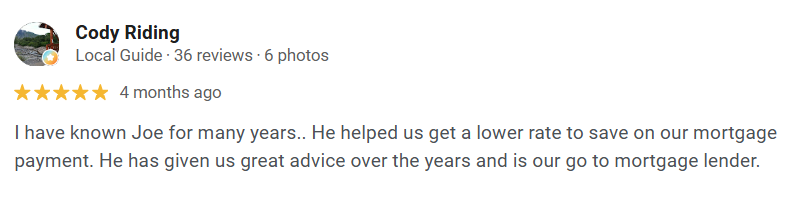
Cody RidingLocal Guide·36 reviews·6 photos I have known Joe for many years.. He helped us get a lower rate to save on our mortgage payment. He has given us great advice over the years and is our go to mortgage lender.
Understanding Today’s Rate Environment in the West Valley
Mortgage rates change daily — sometimes multiple times a day — based on bond market movement, economic data releases, and Federal Reserve expectations. The rate on a website at 9am may be different by 1pm. Any rate you see advertised is a snapshot that applies to a specific borrower profile on a specific day with a specific lock period.
What drives your specific rate, beyond market conditions, is your credit score, loan-to-value ratio, loan type, property type, and whether the property is a primary residence, second home, or investment. Here’s more on how I shop rates across multiple lenders for West Valley buyers. When to Lock Your Rate
Rate locks typically come in 15, 30, 45, or 60-day windows. A 30-day lock is less expensive (or comes with a slightly better rate) than a 60-day lock, because the lender is taking on less market risk. For most Arizona purchase transactions, a 30–45 day lock is appropriate once you’re under contract. Locking too early before you have a signed purchase contract costs money. Waiting too long after you have a contract creates risk if rates move against you before you lock.
Get a Real Rate Quote — With the Full Fee Picture
I’ll send you an actual Loan Estimate — not a one-line rate quote — so you can compare it side by side against any other offer you’ve received. If I’m not the best option for your situation, I’ll tell you that too. That’s how this is supposed to work.(480) 239-7766 — Call JoeAbout Joe Hansen →
Questions Arizona Buyers Ask About Rates and Fees
Q: What are mortgage rates today in Peoria and the West Valley? Rates change daily, and the right answer depends on your credit score, loan type, down payment, and the property you’re buying. As of mid-2026, conventional 30-year rates are in the mid-to-high 6% range for well-qualified borrowers, with FHA and VA often running slightly lower. The most accurate rate for your situation comes from a real pre-approval review — not a website average. Give me a call and I’ll pull actual wholesale pricing for your specific scenario across multiple lenders.
Q: What’s the difference between the interest rate and APR?
The interest rate is what determines your monthly principal and interest payment. The APR (Annual Percentage Rate) is a broader measure that includes the interest rate plus most lender fees — origination charges, points, and certain other costs — expressed as a single annual percentage. A lender with a low advertised rate but high fees will show a significantly higher APR. When comparing lenders, the APR gives you a more complete picture than the rate alone. For the most accurate comparison, use the Loan Estimate’s Section A costs rather than the APR calculation, because APR still has limitations in what it includes.
Q: Is it worth paying discount points to lower my rate?
Sometimes, but only if you’ll keep the loan long enough to break even on the cost. Divide the cost of the points by the monthly payment savings. If you’re paying $4,200 (one point on a $420,000 loan) to save $55/month, break-even is month 76 — over six years. If you expect to sell or refinance before then, the points aren’t worth it. If you’re buying a long-term home and don’t anticipate refinancing soon, paying points can make sense. I run this calculation for every buyer so the decision is based on actual math, not instinct.
Q: Is FHA cheaper than conventional for Arizona buyers?
It depends on your credit score and how long you’ll stay in the home. Below 680, FHA often produces a lower combined monthly cost when you factor in both the rate and the mortgage insurance premium. Above 680–700, conventional typically wins because the PMI cost drops significantly and the rate penalty from LLPAs decreases. The FHA downside is that MIP stays for the life of the loan when you put less than 10% down — conventional PMI falls off when you reach 20% equity. I model both scenarios for every buyer who qualifies for both programs. The right answer requires actual numbers, not a general rule.
Q: How much are closing costs typically in Arizona?
Closing costs in Arizona typically range from 2% to 5% of the purchase price. On a $440,000 home, that’s $8,800 to $22,000 depending on loan type, lender fees, points, and title/escrow costs. The wide range is mostly driven by lender fees and whether points are paid. At Precision Mortgage, we don’t charge a processing fee, and our title partner Precision Title Inc. offers a $250 flat escrow fee — both of which are reflected directly in your Loan Estimate and reduce what you bring to closing.
Q: Can I negotiate lender fees?
Yes — many lender fees are negotiable, and the most effective way to negotiate is to have competing Loan Estimates in hand. Lenders who know you’re comparing often sharpen their pricing when they see a real alternative. Getting Loan Estimates from two or three lenders can save hundreds or thousands of dollars. As a broker, I’ve already done this comparison across multiple wholesale lenders before I present your rate — that competition is baked in rather than something you have to negotiate yourself.
Q: Should I go with a zero-point mortgage or pay points?
In the current rate environment, a zero-point mortgage is often the right call for buyers who may refinance within a few years — either because rates may improve or because their life circumstances may change. A point-paid mortgage makes more sense for buyers who are confident they’ll stay in the home and keep the original loan for a long time. Neither is universally better. The break-even calculation is the deciding factor, and I’ll run it for you with actual current pricing rather than a theoretical example.
Q: Does shopping multiple lenders hurt my credit score?
Not if you shop within a focused window. Credit scoring models treat multiple mortgage inquiries made within a 14 to 45-day period (depending on the scoring model) as a single inquiry. The impact of that single inquiry on your score is minimal — typically 5 points or less. The financial benefit of comparing lenders and saving $2,000 to $5,000 in fees far outweighs any temporary minor score impact. Shop confidently.
Helpful Resources
- Who Has the Lowest Mortgage Rates in Peoria, AZ?
- About Joe Hansen — Peoria, AZ Mortgage Broker
- Get Pre-Approved in Peoria, AZ
- FHA Loans in Arizona — Complete Guide
- #1 Mortgage Broker in Peoria for 2026 — Joe Hansen
- CFPB — How to Read Your Loan Estimate
- CFPB — Explore Mortgage Rates Tool
Joe Hansen Mortgage Loan Officer & Broker · NMLS# 217716 · AZ LO0911403
Joe Hansen is a licensed mortgage broker at Precision Mortgage in Peoria, AZ — named the #1 Mortgage Broker in Peoria for 2026. With over 20 years of experience helping West Valley buyers compare rates and fees across multiple lenders, Joe serves buyers in Peoria, Glendale, Surprise, Sun City, Phoenix, and the entire Phoenix metro area. His approach: show you the full picture, not just the number that looks best.joehansenmortgage.com(480) 239-7766Get Pre-Approved
