
USDA Loans in Arizona: 0% Down, 100% Home — Everything You Need to Know
USDA Home Loans · Arizona · Zero Down Payment · 2026
Most Arizona buyers have never heard of the USDA loan. That’s a shame — because for buyers purchasing in eligible areas, it’s one of the most powerful mortgage programs available. Zero down payment. 100% financing. And it may apply to homes closer to the Phoenix metro than you’d ever expect. By Joe Hansen, NMLS# 217716 · Precision Mortgage, Peoria AZ · Updated 2026 0% Down Payment Required USDA Section 502 Guaranteed Loan · 100% Financing for Eligible Arizona Homes
The USDA loan is the most underused mortgage program in Arizona. Buyers who’ve been scraping together a down payment, looking at FHA programs, or assuming homeownership has to wait — often discover they could have been in a home months earlier with zero down if only someone had mentioned the USDA. This guide covers everything you need to know: how the program works, what areas in Arizona are eligible, how income limits are applied, and how to use seller concessions and financing strategies to get into a home with as little out of pocket as possible. 0% Down 100% financing — no down payment required for eligible borrowers ~96% Of Arizona’s land area is USDA-eligible by geography 0.35% Annual USDA guarantee fee — less than FHA’s annual MIP
What Is the USDA Loan?
The USDA Single Family Housing Guaranteed Loan Program — administered by the U.S. Department of Agriculture’s Rural Development division — is a government-backed mortgage program specifically designed to help low-to-moderate income buyers purchase homes in eligible rural and suburban areas. Like VA and FHA, the USDA doesn’t lend money directly. Instead, it guarantees loans made by approved private lenders, which reduces the lender’s risk and allows them to offer 100% financing with competitive interest rates.
The program has been around since 1991 and has helped millions of American families buy homes without a down payment. In Arizona, it’s used far less frequently than it should be — primarily because buyers and even some real estate agents assume that “rural” means far-out desert, far from the metro. That assumption is wrong in ways that change the entire picture. Not Just for Farmers
The USDA loan has nothing to do with farming or agricultural use. You don’t need land. You don’t need a barn. You don’t need to grow anything. The program uses USDA’s definition of “rural” — which is based on population and census data, not how the property looks or what it’s used for. Plenty of USDA-eligible homes in Arizona are standard subdivision houses in quiet communities that just happen to fall outside the metro boundary.
The Arizona USDA Eligibility Map: Rural Is Closer Than You Think
This is the part that surprises most Arizona buyers. When people hear “USDA rural loan,” they picture a property hours from anywhere. The reality is very different.
Only about 3.9% of Arizona’s total land area is ineligible for USDA rural development loans. The ineligible areas are the densely populated urban cores — the Phoenix metro, Tucson, Flagstaff, and similar built-out areas. Everything outside those boundaries is generally eligible. And those boundaries begin much closer to the Valley’s edge than most buyers realize.
Communities along the outer edges of the Phoenix metro — and those just beyond it — may fall squarely inside USDA-eligible territory. Black Canyon City, for example, is just approximately 22 miles north of Phoenix along Interstate 17. Wickenburg and surrounding rural areas in Maricopa County continue to see USDA Rural Development eligibility for most census tracts based on current population and income criteria. Communities in Yavapai County like Mayer, Cordes Lakes, and Mayer are also in eligible zones. To the west, outer portions of the Buckeye and Gila Bend corridors have historically included eligible pockets.
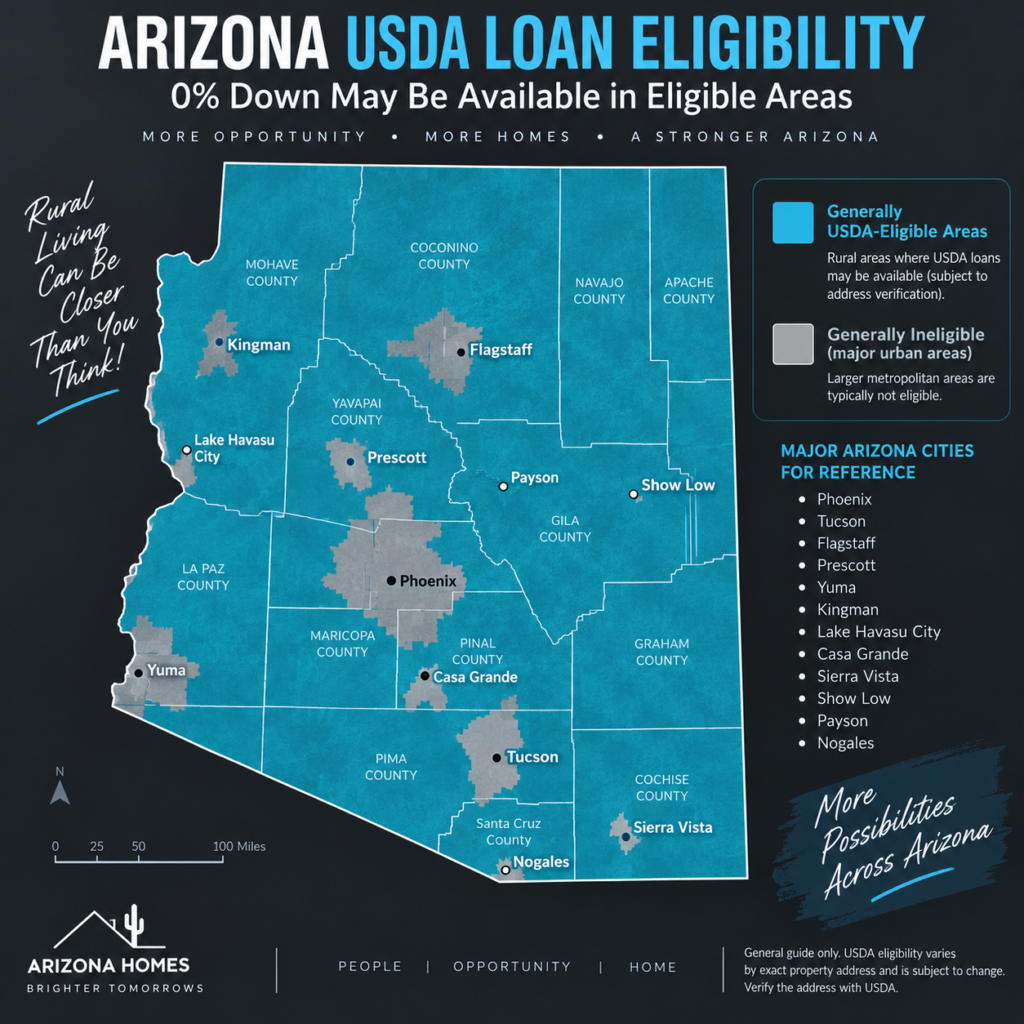
Use your USDA map screenshot with the caption below. The shaded/tan-orange area = NOT eligible. The unshaded area = potentially USDA-eligible.
Suggested caption: “USDA 0% Down — Closer to Phoenix Than You Think. Shaded Gray = Not USDA Eligible · Unshaded Blue = Potentially Eligible. Send me the property address, and I’ll check USDA eligibility for free.” Always Verify at the Address Level
USDA eligibility is determined property by property — not by city or zip code alone. A subdivision on one side of a road may be eligible while the homes across the street are not. Eligibility maps also change periodically as census data updates. The only reliable way to confirm USDA eligibility for a specific property is to run the address through the official USDA eligibility lookup or ask me to check it for you — takes about two minutes and I do it for free.
Official USDA eligibility lookup: eligibility.sc.egov.usda.gov
Arizona Communities Worth Knowing for USDA Buyers
Here are some Arizona communities that have historically been USDA-eligible or sit near the eligibility boundary — worth verifying at the address level before making any assumptions: Black Canyon City ~22 miles north of Phoenix · I-17 corridor · Yavapai County A small unincorporated community with a genuine small-town character and easy freeway access. Larger lots, rural feel, and easy commute access north of the metro. Historically USDA-eligible. Wickenburg ~55 miles northwest of Phoenix · Maricopa & Yavapai Counties A historic Arizona town with strong Western character, equestrian properties, and larger parcels. USDA eligibility confirmed for most census tracts. Popular with buyers wanting more space and a slower pace. Mayer / Cordes Lakes ~55 miles north of Phoenix · Yavapai County Quiet high-desert communities with affordable home prices. Active USDA listings have been recorded here. Values remain accessible compared to the metro. Gila Bend Area ~70 miles southwest of Phoenix · Maricopa County Rural pockets west of the metro. Buyers seeking larger lots, desert land, and lower price points. Eligibility varies by parcel — always verify the specific address. Aguila / Wittmann ~50–60 miles northwest of Phoenix · Maricopa County Outer Maricopa County communities beyond the metro edge. Historically included USDA-eligible pockets with larger lot properties and rural character. Florence / Coolidge Area ~55 miles southeast of Phoenix · Pinal County Parts of Pinal County beyond the metro boundary may qualify. Growing communities with affordable prices and active USDA loan activity. Verify each address.
This list is meant to give you a starting point — not a guarantee. The boundary is determined at the parcel level. If you have a specific address you’re considering anywhere in Arizona, send it to me and I’ll check it against the current USDA map in minutes.
How the Zero Down Payment Actually Works
Let’s be specific about what “0% down” means in a USDA transaction — because it’s different from how most buyers assume.
With a USDA loan, you do not make a down payment. The loan amount covers 100% of the purchase price. There is no minimum buyer contribution required for the down payment itself. However, you are still responsible for closing costs — things like lender fees, title insurance, prepaid taxes, homeowners insurance, and recording fees. Those don’t disappear just because the down payment does.
Here’s where it gets even more useful: USDA allows eligible closing costs to be financed into the loan — but only if the home appraises for more than the purchase price. If the appraised value exceeds the purchase price, the difference can be used to roll in closing costs up to the appraised value. This can result in a buyer truly closing with almost nothing out of pocket. Example: USDA Purchase With Closing Costs Financed · Black Canyon City, AZ Purchase price $285,000 Appraised value $298,000 Room to finance closing costs (appraisal overage) $13,000 Estimated closing costs and prepaids ~$9,500 Closing costs rolled into loan $9,500 Down payment required $0 Buyer’s cash to close Near $0 — potentially just earnest money
And if the appraisal doesn’t come in above the purchase price? Seller concessions are another excellent tool. USDA allows seller contributions toward eligible closing costs — and structuring an offer to include a seller credit can accomplish the same goal. Learn more about how seller concessions work in Arizona here. Gift Funds on USDA Loans
USDA also allows gift funds from eligible donors — family members, employers, nonprofits — toward closing costs and reserves. Because there’s no down payment requirement, gift funds don’t need to go toward a down payment specifically. They can cover any remaining out-of-pocket costs. Learn more about using gift funds to buy a home in Arizona.
USDA Income Limits in Arizona: What They Are and How They Work
Here’s the piece that eliminates some buyers from USDA — but surprises many others who assume they make too much. USDA income limits are household limits, not individual income limits. Everyone in the household whose income could reasonably be expected to continue is counted — whether they’re on the loan or not. Your spouse, adult children living at home, working family members — their income may count even if they’re not borrowers.
The good news is that these limits are set at 115% of the area median income (AMI) for the location, and they increase with household size. The limits vary by county and area — and in some Arizona communities, they’re higher than buyers expect.
| Household Size | Standard Income Limit (Many AZ Areas) | Higher Limit (Some Metro-Adjacent Areas) |
|---|---|---|
| 1–4 person household | ~$110,650 | ~$127,950 (varies by area) |
| 5–8 person household | ~$146,050 | ~$168,900+ (varies by area) |
Income limits change annually and vary by county and community. Always verify current limits for the specific area you’re purchasing in. These figures are illustrative — confirm exact limits at rd.usda.gov or ask me to run them for your specific situation. You May Qualify Even With a Solid Income
A family of four with a combined household income under roughly $110,000–$128,000 (depending on location) can qualify for a USDA loan. That covers a significant portion of Arizona working families — not just low-income buyers. If you’ve assumed USDA isn’t for you because your income is decent, it’s worth actually checking the numbers for your household size and the specific area you’re targeting.
Debt-to-Income Ratios: The Benchmarks and the Flexibility
USDA uses two DTI ratios when evaluating borrowers — the housing ratio and the total debt ratio. The standard benchmarks are: 29% housing ratio — Your proposed monthly mortgage payment (principal, interest, taxes, insurance, and the annual USDA guarantee fee) should generally not exceed 29% of your gross monthly income. 41% total debt ratio — Your total monthly debt obligations — mortgage plus all other recurring debts — should generally not exceed 41% of your gross monthly income.
These are guidelines, not hard ceilings. USDA’s Guaranteed Underwriting System (GUS) can approve files that exceed these ratios when compensating factors are present — strong credit scores, low overall debt, significant reserves, a history of paying comparable housing costs, or other stabilizing factors. Manually underwritten files also provide some flexibility above these benchmarks when supported by documentation.
In practice, buyers who come in with a 680+ credit score, stable employment, and clean credit history often receive automated approvals through GUS even when DTI pushes above the 29/41 standard. This is one of the reasons a pre-approval conversation — rather than a self-calculation — is important before a USDA buyer decides they don’t qualify.
Who Qualifies: No First-Time Buyer Requirement

One of the most commonly misunderstood aspects of the USDA loan is the buyer eligibility question. You do not have to be a first-time homebuyer to use a USDA loan. Repeat buyers qualify as long as they meet the income and property requirements. However, there is one important caveat: you cannot currently own an adequate primary residence and use a USDA loan to buy another one. If you already own a suitable home, the USDA program is designed for buyers who are moving into or within eligible areas — not adding properties. Citizenship/residency: U.S. citizens, U.S. non-citizen nationals, and qualified aliens are eligible. Lawful permanent residents may qualify under certain conditions. Credit: No official minimum credit score in USDA guidelines, though most lenders want a 640+ for automated underwriting through GUS. Scores below 640 may be possible through manual underwriting with strong compensating factors. Employment history: Stable, consistent income for at least two years is the standard expectation. Self-employed borrowers follow similar documentation requirements as other loan programs. Debt-to-income: Standard 29/41 benchmarks with flexibility for strong files as described above. First-time buyer? Not required. You can have owned a home previously — you just can’t currently own an adequate primary residence.
What Types of Arizona Properties Qualify for USDA?
Another common misconception: USDA loans are only for site-built single-family homes on large rural lots. That’s not accurate. The program has broader property eligibility than most buyers realize. Site-built single-family homes — The most common USDA property type. Standard houses in eligible areas, including those on modest lots in rural communities. Condominiums — Eligible condos in USDA-approved projects can qualify. The project must meet USDA’s requirements, similar to how condo financing works under other programs. Planned Unit Developments (PUDs) — Common in Arizona — townhome-style properties in planned communities — can qualify for USDA financing when the project and property meet program standards. Modular homes — Factory-built modular homes that are permanently affixed to a foundation and titled as real property can qualify. Common in some Arizona rural communities. Certain manufactured homes — USDA allows financing on certain manufactured homes meeting HUD construction standards, subject to specific requirements regarding foundation, age, and titling as real estate rather than personal property. Homes with wells and septic systems — A significant number of eligible Arizona rural properties use private wells and septic systems rather than municipal water and sewer. USDA allows these — the well and septic must be functional and meet local health standards. An inspection of both is typically required. Larger lots — There’s no strict maximum lot size for USDA eligibility, though the home must be the primary use of the property. Acreage that suggests agricultural or commercial use may create complications, but a rural home on a few acres is typically fine. Wells and Septic in Arizona — A Real Advantage
Many of the most attractive rural Arizona properties — those with mountain views, privacy, larger lots, and the space that draws people out of the metro — sit on private wells and septic systems. Some programs treat these as complications. USDA treats them as normal. If you’re looking at a home in Black Canyon City with a well and a half-acre lot, or a property outside Wickenburg with a septic system, USDA financing may be perfectly suited to that transaction.
The USDA Guarantee Fee: What It Costs and How It Compares
USDA loans are not completely free of mortgage insurance — but the structure is more favorable than FHA in some meaningful ways. USDA Guarantee Fee Structure vs. FHA MIP — $290,000 Loan USDA upfront guarantee fee (1.0% of loan amount) $2,900 — rolled into loan USDA annual fee (0.35% of remaining balance) ~$85/month initially FHA upfront MIP (1.75% of loan amount) $5,075 — rolled into loan FHA annual MIP (0.55% — most 30-yr loans under 10% down) ~$133/month initially USDA monthly MI advantage vs. FHA ~$48/month less
The USDA annual fee of 0.35% is meaningfully lower than FHA’s 0.55% annual MIP — a difference that adds up significantly over years of homeownership. The upfront fee is also lower. For buyers who qualify for both programs and the property is in an eligible area, the USDA loan is often the better financial product even if the rate is comparable.
Both the upfront guarantee fee and the annual fee can be reduced or eliminated if Congress adjusts USDA program funding — this has happened before and may happen again. But planning around current fee levels is the prudent approach.
USDA vs. FHA vs. VA: Which Zero or Low Down Payment Option Is Right?
| Feature | USDA | FHA | VA |
|---|---|---|---|
| Down payment | 0% | 3.5% | 0% |
| Who can use it | Any qualified buyer — income limits apply | Anyone who qualifies | Veterans, active duty, surviving spouses only |
| Property location | Must be in USDA-eligible area | No geographic restriction | No geographic restriction |
| Mortgage insurance | 0.35% annually + 1.0% upfront | 0.55% annually + 1.75% upfront | None — funding fee only (waived for disabled vets) |
| Income limits | Yes — 115% of AMI | No income limits | No income limits |
| Min. credit score | 640+ (GUS) / lower with manual UW | 580+ for 3.5% down | No official minimum |
| Best for | Non-veteran buyers in eligible rural/suburban areas | Lower credit, urban/suburban, any area | Any eligible veteran — strongest overall program |
For non-veteran buyers who need zero down and the property is in a USDA-eligible area, the USDA loan is often the best option available. It combines zero down payment with lower annual MI than FHA and competitive interest rates. See all first-time buyer loan options for the Peoria area here.
Send Me the Address — I’ll Check USDA Eligibility in Minutes
Not sure if a property qualifies? Give me the address and I’ll run it against the current USDA eligibility map and give you a straight answer. If it qualifies, I’ll show you exactly what a USDA purchase would look like — payment, fees, and how much you’d need to bring to closing. If it doesn’t qualify, I’ll show you the best alternative that fits your situation.(480) 239-7766 — Call JoeCompare Current Rates →
Frequently Asked Questions About USDA Loans in Arizona
Q Is there really no down payment with a USDA loan?
Correct — the USDA Section 502 Guaranteed Loan requires zero down payment. You finance 100% of the purchase price. You are still responsible for closing costs unless they can be rolled into the loan (when the appraisal supports it) or covered by a seller concession. But the down payment itself is genuinely zero. This is one of only two mortgage programs — the other being the VA loan — that offers true 100% financing.
Q Do I have to be a first-time homebuyer?
No. There is no first-time buyer requirement on USDA loans. Repeat buyers are welcome as long as they meet the income limits, the property is in an eligible area, and they don’t currently own an adequate primary residence. If you owned a home previously and sold it, you’re fully eligible. If you’re selling your current home and moving to a USDA-eligible area, that works too — as long as the timing is structured correctly.
Q How do I know if a property near Phoenix is USDA-eligible?
The only reliable method is to check the specific address against the current USDA eligibility map at eligibility.sc.egov.usda.gov. Eligibility is determined parcel by parcel, not by city or zip code. Communities like Black Canyon City (~22 miles from Phoenix on I-17) and Wickenburg (~55 miles northwest) have historically been eligible. But boundaries change, and a single address check is the only way to know for certain. I do this for buyers for free — just send me the address.
Q Can closing costs really be financed into a USDA loan?
Yes — when the home appraises for more than the purchase price, eligible closing costs can be financed into the loan up to the appraised value. If the home appraises exactly at the purchase price, closing costs cannot be rolled in. This is why an early appraisal expectation conversation matters. If rolling in costs isn’t possible due to the appraisal, seller concessions are the alternative path — and USDA allows seller contributions toward eligible buyer costs.
Q What are the income limits for a USDA loan in Arizona?
Income limits are based on 115% of the area median income for your specific location and are adjusted for household size. For most Arizona rural areas, a household of 1–4 people can earn up to approximately $110,000–$128,000 annually and still qualify — though the exact number depends on the county and area. Household size matters significantly — a larger household has a higher limit. These limits update annually. I can pull the current limits for any specific area in Arizona during a pre-approval conversation.
Q Can I get a USDA loan on a home with a well and septic?
Yes. USDA loans are well-suited to Arizona rural properties with private wells and septic systems. Both must be functional and meet applicable local health and safety standards. A well water test and septic inspection are typically required as part of the transaction. If you’re looking at a Black Canyon City property with a well, or a Wickenburg home with a septic system, USDA doesn’t treat those as obstacles the way some other programs might.
Q Is the USDA loan slower to close than other loans?
It can be slightly longer because USDA-approved loans require a conditional commitment from the USDA Rural Development office in addition to the lender’s approval — this adds a processing step. In most cases, this adds about a week to the typical timeline. Plan for 35–45 days from application to closing on a USDA loan rather than the 30 days that a conventional or FHA loan might achieve. Building a slightly longer closing window into your purchase offer is a good practice for USDA transactions.
Q Can I use a USDA loan and seller concessions together?
Absolutely — and this combination is one of the most powerful ways to minimize out-of-pocket costs on a USDA purchase. Because there’s no down payment, any seller credit goes toward closing costs and prepaids — meaning a buyer could potentially close with very little cash at all. USDA allows seller contributions toward eligible costs with no specific percentage cap beyond the limitation that seller concessions cannot exceed actual closing costs. See how to structure seller concessions in Arizona here.
Helpful Resources
- Official USDA Property Eligibility Map — Check Any Arizona Address
- USDA Income Limits by Area — Official USDA Rural Development
- First-Time Homebuyer Loans in Peoria, AZ
- Seller Concessions in Arizona — How to Use a Seller Credit
- Can I Use Gift Funds to Buy a Home in Arizona?
- Who Has the Lowest Mortgage Rates in Peoria, AZ?
Joe Hansen Mortgage Loan Officer & Broker · NMLS# 217716 · AZ LO0911403
Joe Hansen is a licensed mortgage broker at Precision Mortgage in Peoria, AZ — named the #1 Mortgage Broker in Peoria for 2026. With over 20 years of Arizona mortgage experience, he helps buyers across Peoria, the West Valley, and the greater Phoenix area find the right loan program for their situation — including USDA, FHA, VA, conventional, and down payment assistance programs. If you’re wondering whether a property qualifies for USDA financing, a quick call gets you an answer.joehansenmortgage.com(480) 239-7766Homebuyer Loans

Precision Mortgage, Inc. | 14155 N 83rd Ave Ste 125, Peoria, AZ 85381 | NMLS# 217716 | AZ LO0911403. This content is for informational purposes only and does not constitute a loan commitment or guarantee of terms. USDA loan eligibility — including geographic eligibility, income limits, credit requirements, and property standards — is subject to change and varies by location and individual borrower profile. Eligibility must be verified for each specific address and borrower. Income limit figures shown are approximate and may differ from current published limits for specific areas and household sizes. All loans subject to credit, income, and property qualification. Contact a licensed loan officer for a personalized assessment.
